
Everyday Carry & Tech · Roundup · Pro · DIY
Toolbag Cable and Charger Kit: What to Carry on the Job
Quick answer
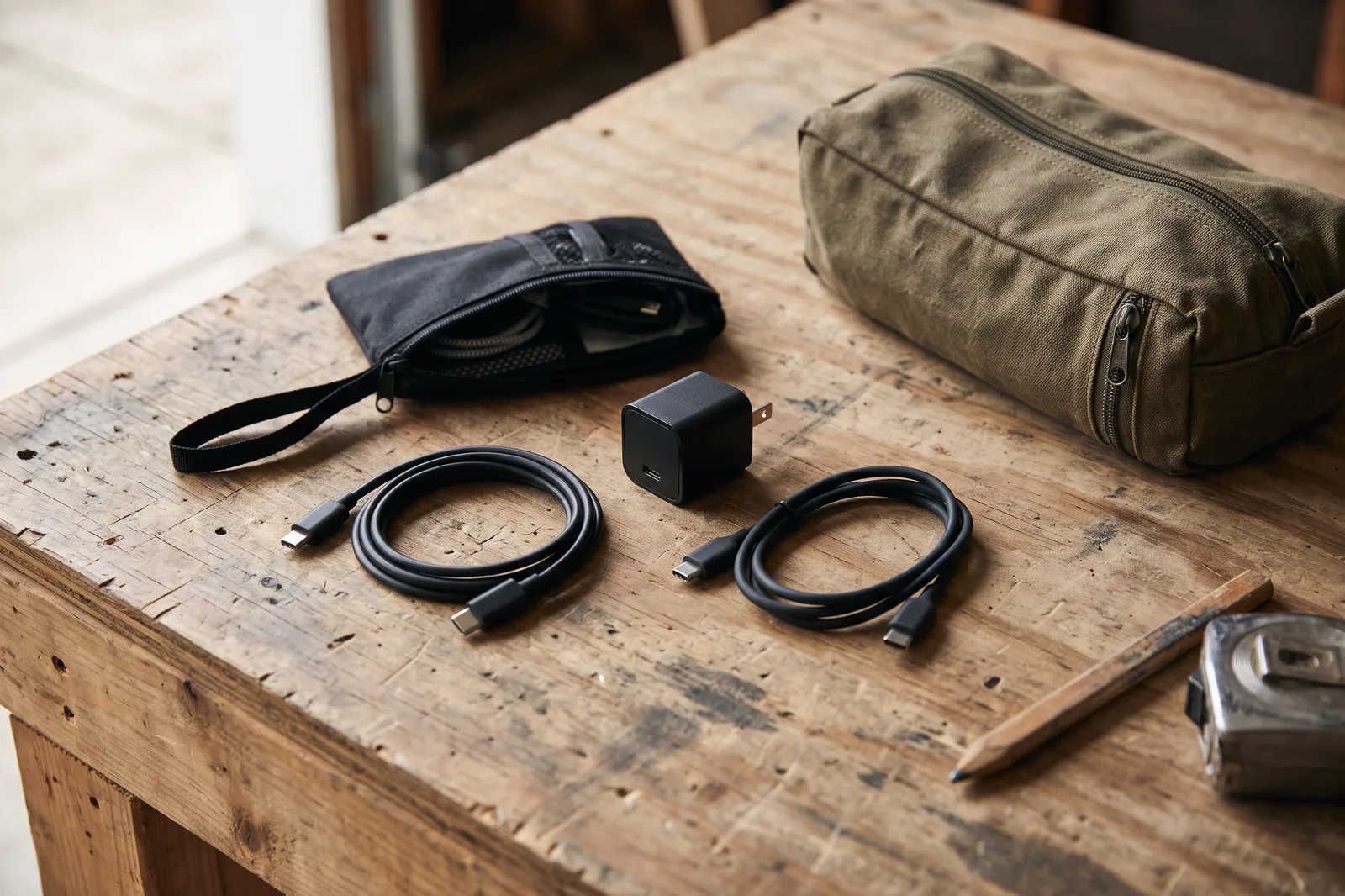
A toolbag charging kit is a compact USB-C wall charger, one or two sturdy USB-C cables and a small pouch that keeps them together. The Anker Nano 45W charger with its included 6 ft cable is a good core, the Amazon Basics 60W cable is a low-cost spare, the Anker PowerLine III Flow adds a tougher, higher-rated cable, and a tomtoc pouch stops it all turning into a tangle. Skip the kit if you only ever charge at your desk.
What is a toolbag cable and charger kit?
A toolbag charging kit is a small set of charging gear that lives in your toolbag or truck so your phone never dies mid-job. It has three parts: a compact wall charger, one or two USB-C cables and a pouch that keeps them together. The point is simple. You stop borrowing a cable, stop hunting for the one that actually fits, and stop using a worn one that charges at a crawl.
Here is the short version of which to get:
| If you... | Get | Why |
|---|---|---|
| Want one charger that does phone and laptop | Anker Nano 45W | A 45W USB-C charger with a foldable plug and a 6 ft cable in the box, per the listing |
| Want a tough cable with plenty of headroom | Anker PowerLine III Flow | Rated up to 240W with a soft, tangle-resistant jacket |
| Want a low-cost spare cable | Amazon Basics 60W | USB-IF certified and rated for 60W, per the listing |
| Want it all in one place | tomtoc Light-T12 pouch | A 1 L pouch that stands up in a bag and has sorted compartments |
A few terms, in plain words:
- USB-C is the oval plug on most phones and laptops. It plugs in either way up.
- Watts (W) measure how much power flows. More watts means faster charging, if the charger, cable and device all support it.
- GaN (gallium nitride) is the material that lets a charger be small without running hot. The Nano listing names it.
- Data speed is how fast files move over the cable. Both cables here are USB 2.0, 480 Mbps, which is fine for charging and small files.
Why you'll want one
A dead phone costs time. Photos, measurements, calls and directions all run on the phone. A kit that is always packed removes the "who has a charger?" delay.
The cable sets the speed, not just the charger. In the Everyday Tech Gear video, one device charged from the same charger with three cables. A 60W cable held at about 56W, a 100W cable at about 95W and a 240W cable at about 134W, so charge time went from 34 minutes to 20 to 14. A cable you have never checked can quietly slow a good charger.
Cables differ in how long they last. Consumer Reports bent six USB-A to USB-C cables until they failed and found the Amazon Basics cable survived the most bends, with Anker and Belkin braided cables lasting roughly half as long. MobileReviewsEh, in a separate test, bent a dozen newer cables over a million times in total and said many failed. The lesson from both is to buy a cable with a track record and to carry a spare.
One small charger replaces three. The Anker Nano charges a phone at full speed and can also top up a tablet or small laptop, so one block can cover most of the bag.
A pouch ends the tangle. The tomtoc listing shows separate compartments for a charger and cables, and a design that stands upright so you can see everything.
| Problem | What fixes it |
|---|---|
| Slow charging on site | A rated cable and a 45W charger |
| Frayed or kinked cable | A tougher jacket and a loose coil |
| Cables lost in the bag | One pouch that lives in the toolbag |
| Needing both phone and laptop power | A 45W charger and a 60W or 240W cable |
Who it's for
- Tradespeople and tool users who charge a phone, headlamp or radio from a truck or an extension cord
- Homeowners who want one set of cables and a charger that lives in the garage toolbox
- Anyone with a battery pack who keeps losing the right cable for it
- People with a laptop and a phone who want one USB-C charger for both
Who should skip it
- Anyone who only charges at a desk. A drawer cable is enough.
- Anyone who needs to charge a large laptop at full speed. A 45W charger is gentle for big machines, so look at a higher-wattage charger.
- Anyone with an older phone or devices without USB-C. Check your port before you buy.
How to use your charging kit
- Pick one home for the kit. Put it in the toolbag you carry most, such as a stackable tool box or a truck bag.
- Start with the charger. The Anker Nano comes with its own 6 ft cable. That pair is your main set.
- Add a second cable. A budget cable such as the Amazon Basics keeps one in the truck and one in the bag.
- Add a tougher cable for hard use. If you charge a laptop or want a longer-lasting jacket, the PowerLine III Flow is the step up.
- Label by length. Put a small mark on a short cable and a long cable so you reach for the right one.
- Coil loosely. Loop in wide circles and avoid sharp folds at the connector, where cables usually fail.
- Fold the plug in before you pack. The Nano's prongs fold flat so they will not scratch the pouch or other tools.
- Close the pouch every time. A closed pouch stops cables catching on other gear.
- Check the kit monthly. Look for bent connectors, frayed jackets and loose fits, and replace one that looks tired.
- Pair it with a power bank if you work far from outlets. Our phone battery pack guide explains capacity.

What to avoid
| Mistake | What happens | Fix |
|---|---|---|
| Using one cable for everything | It fails first and you lose your charging | Carry a spare |
| Folding a cable tight at the plug | The wire inside breaks | Coil loosely |
| Using an unrated cable with a laptop | Charging is slow or does not work | Buy a cable rated for the power you need |
| Leaving a cable in a hot truck | The jacket can harden and crack | Keep it in the pouch in the bag |
What testers and owners say
- Anker Nano 45W. TechRadar called the version with a USB-C cable a fantastic phone charger and said it had quickly become its go-to option. The charger has a single USB-C port, per the listing.
- Anker PowerLine III. TechGearLab named the PowerLine III USB-C its Best Overall cable and gave it a 9.0 for durability and a 76 overall. Its testers measured up to 95W and noted only USB 2.0 data speed and a light jacket that can discolour. Anker's listing for the Flow version quotes a 25,000-bend lifespan, a maker figure.
- Amazon Basics. The listing names a 60W rating, 480 Mbps, USB-IF certification, a 5,000-bend test and a 1-year warranty. Consumer Reports' bend test found an Amazon Basics USB-A to USB-C cable the most durable of six.
- tomtoc Light-T12. Nomads Nation recommends the small and medium sizes for minimal cable and accessory kits and says they are not for large devices.
- Owner experience. A Jojo's Picks reviewer says braided Anker USB-C cables kept charging as fast after two years of daily use.

What to look for when buying
- A power rating that matches your devices. 60W covers phones and tablets. Choose 100W or 240W if a laptop is in the picture.
- A reputable brand or a certified cable. USB-IF certification, as on the Amazon Basics pick, means it was checked against the standard.
- A jacket that suits your work. Silicone is soft and tangle-free; braided cables are common and tough. TechGearLab notes light jackets show dirt.
- Length that fits your routine. Six feet reaches a bench; shorter cables stow easily.
- A compact charger with a foldable plug. It will not damage the pouch or other tools.
- An honest warranty. The Anker Nano lists 18 months and the Amazon Basics cable 1 year.
- A pouch that closes and stands up. The tomtoc is about one litre, so it fits a charger and a few cables, not a laptop brick.
- The right companion gear. A headlamp and a rugged phone case charge from the same cables, and a multimeter stays in the same bag.

Key specs to look for
| Spec | What to look for |
|---|---|
| Cable power rating (watts) | A cable is rated for a maximum. The Amazon Basics pick is 60W and the Anker PowerLine III Flow is 240W, per the listings. For phones 60W is plenty. Choose a higher rating if you will charge a laptop. |
| Charger output | The Anker Nano is 45W maximum. That charges a phone at full speed and a small laptop or tablet more slowly, which is why one cable and one charger make a good pair. |
| Cable length | Six feet reaches from a wall outlet to a bench or tailgate. A shorter cable is easier to stow, so many people carry one of each. |
| Data speed | Both cables here are USB 2.0 at 480 Mbps. That is fine for charging and small files and slow for copying large video. |
| Connector and jacket | Look for reinforced ends and a jacket that bends without kinking. Anker lists a 25,000-bend lifespan and Amazon Basics a 5,000-bend test, so the two are rated differently. |
| Certification | A USB-IF certified cable such as the Amazon Basics pick has been checked against the USB standard. Unlabelled cables can look identical but carry less power. |
| Warranty | The Anker Nano listing names an 18-month warranty and the Amazon Basics cable a 1-year limited warranty. |
| Pouch size | Big enough for a charger and two cables with room to spare, small enough to drop into the toolbag. The tomtoc pouch holds about one litre. |
Where to get a toolbag charging kit
Our four picks are below, based on listings, tests and owner videos.

Anker Nano Charger, 45W USB-C Fast Charger with 6 ft USB-C Cable and Foldable Plug
- A pocket-sized GaN charger with a foldable plug and a 6 ft USB-C cable in the box, per the listing
- TechRadar's review called the Nano 45W with its cable a fantastic phone charger and its go-to option
- It has a single USB-C port, so it charges one device at a time
How we scored it
Usefulness 9/10 · Value 8/10 · Durability 8/10. This is our own opinion, based on specs, buyer reviews and independent tests. It is not an Amazon or customer rating.

Anker USB C Cable, 240W Type C Fast Charging Cord, 6 ft, Black (PowerLine III Flow)
- Rated by the maker for up to 240W and a 25,000-bend lifespan, with a soft silicone finish that stays tangle-free in a bag
- TechGearLab named the PowerLine III USB-C its best overall cable and gave it a durability score of 9.0
- Data speed is only USB 2.0 (480 Mbps), and TechGearLab notes light jackets can discolour and show dirt
How we scored it
Usefulness 9/10 · Value 8/10 · Durability 8/10. This is our own opinion, based on specs, buyer reviews and independent tests. It is not an Amazon or customer rating.

Amazon Basics USB-C to USB-C 2.0 Fast Charger Cable, 60W, 480 Mbps, USB-IF Certified, 6 ft
- A USB-IF certified 6 ft cable rated for 60W and 480 Mbps, tested to bend 95 degrees 5,000 times, per the listing
- In Consumer Reports' bend test, an Amazon Basics USB-A to USB-C cable survived the most bends of six cables, which says something good about the brand but not about this exact model
- At 60W it will not fully speed up a laptop, and the listing warns not to exceed its rated load
How we scored it
Usefulness 8/10 · Value 9/10 · Durability 7/10. This is our own opinion, based on specs, buyer reviews and independent tests. It is not an Amazon or customer rating.

tomtoc Electronics Organizer Travel Case, Water Resistant Tech Pouch (Light-T12)
- A 1 L pouch of recycled 600D polyester that measures 9.25 x 2.56 x 4.72 in and stands upright, per the listing
- Nomads Nation recommends the small and medium sizes for minimal cable and accessory kits
- It is sized for light carry, not for bulky chargers or a laptop
How we scored it
Usefulness 8/10 · Value 8/10 · Durability 7/10. This is our own opinion, based on specs, buyer reviews and independent tests. It is not an Amazon or customer rating.
Watch and read more
Video reviews
- USB Cables Have Speeds?! 60W vs 100W vs 240W Charging Test — Everyday Tech Gear
Charges the same device from the same charger with a 60W, a 100W and a 240W cable and times each: about 34, 20 and 14 minutes. - Top 3 USB-C Cables Of 2025 - I Bent These Cables Over 1 Million Times! — MobileReviewsEh
Bends a dozen cables over a million times in total and ranks the top three. It does not test the cables in this article but shows how big the gap between cables can be. - Anker 6ft USB C Cables: 2-Year Durability Test & Review — Jojo's Picks
An owner reports two years of daily use on braided Anker USB-C cables rated up to 100W with no loss of charging speed. These are braided cables, not the silicone Flow cable here.
Frequently asked questions
Does the wattage on a USB-C cable matter?
Yes. A cable carries only as much power as it is built for. In the Everyday Tech Gear video, the same device and charger held about 56W on a no-name cable, about 95W on a 100W cable and about 134W on a 240W cable, and the full charge went from 34 minutes to 20 to 14.
Do I need a 240W cable for my phone?
No. A phone draws far less than 60W. A 240W cable is mainly future-proofing, and it helps if you charge a laptop from the same cable.
Is a more expensive cable always tougher?
Not always. Consumer Reports found an Amazon Basics USB-A to USB-C cable outlasted Anker and Belkin braided cables in a bend test. Test results belong to specific models, so check the cable you buy and carry a spare.
Will a 45W charger harm a phone that charges at less?
No. The phone and the charger agree on how much power to send, so the phone only takes what it can use. A higher-wattage charger simply has more headroom.
Why does my cable charge slowly even with a fast charger?
The slowest part sets the speed. An older or lower-rated cable, a worn connector or a low-power port will limit the charge. Try a rated cable and a different outlet.
How should I coil a cable so it lasts?
Loop it loosely in wide circles instead of folding it tight at the connector. A pouch with separate compartments stops cables twisting into a knot.
Should I add a power bank to the kit?
If you work away from outlets, yes. A power bank plus a short cable covers the day. See our phone battery pack guide for how much capacity to buy.
Sources
Related tools
 Everyday Carry & TechPhone Battery Pack: Pocket Power for the Jobsite and the RoadA phone battery pack, also called a power bank, is a pocket-size rechargeable battery that charges your phone through a cable when there is no outlet nearby.
 Everyday Carry & TechRugged iPhone Case: Cheap Insurance for the Phone You Carry EverywhereA rugged iPhone case is a thick, layered cover with raised edges that absorbs drops, dust and scrapes.
 Workshop & Storage · RoundupStackable Tool Box Systems: Which One to Own for Home and JobsiteA stackable tool box system is a set of boxes that click together so one stack carries everything.