
Measuring & Layout · Roundup · Pro · DIY
Multimeters and Voltage Testers: Which to Own at Home
Quick answer
A non-contact voltage pen tells you if a wire may be live, a plug-in outlet tester checks wiring on the spot, and a multimeter gives actual numbers. Most homeowners should own a pen and an outlet tester first, then add a compact multimeter like the Fluke 107. Never trust a pen alone: reviewers have shown pens that miss live circuits.
What are multimeters and voltage testers?
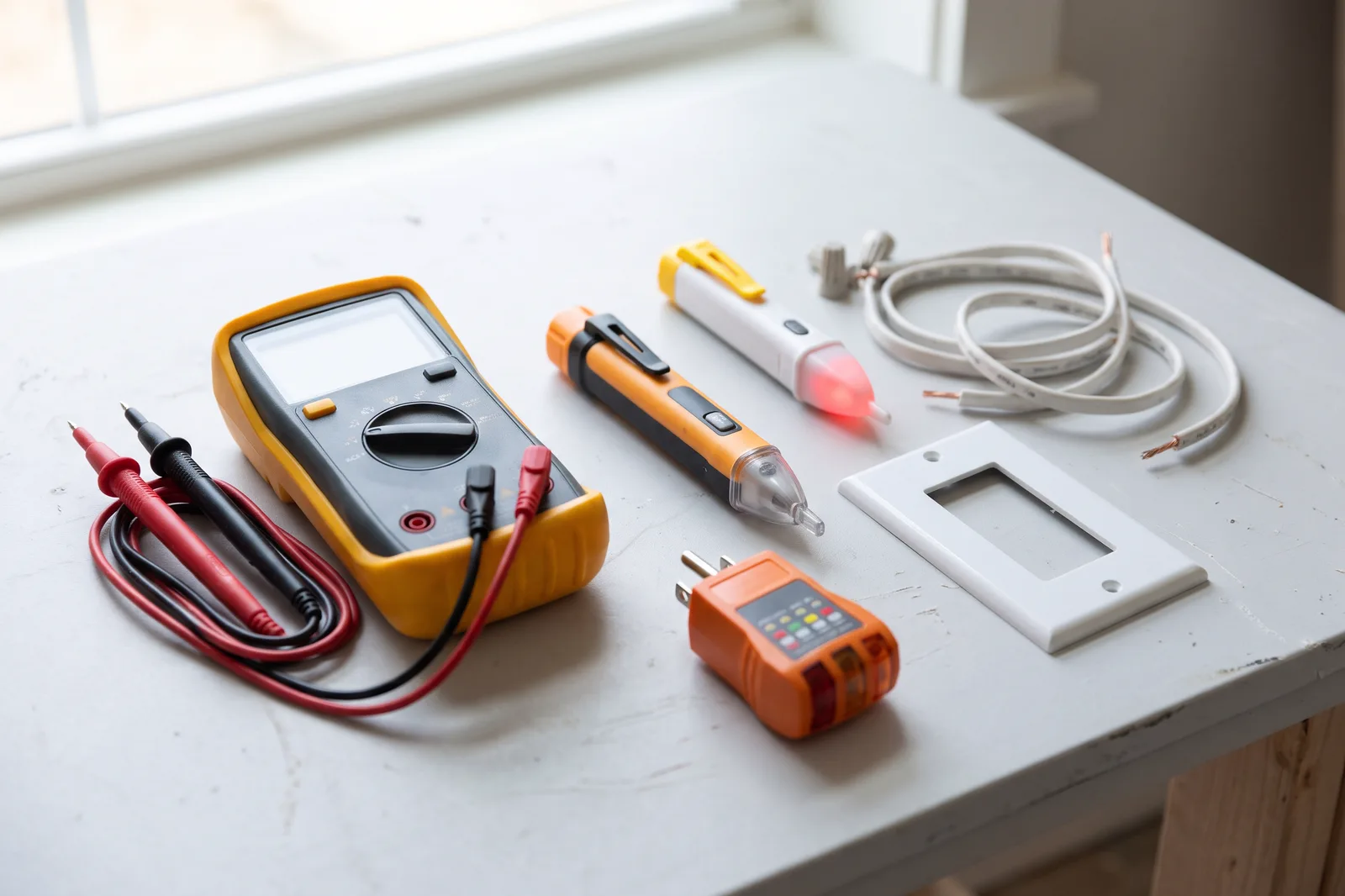
Electrical checkers are small tools that tell you if power is present and if a circuit is wired correctly. Three types cover most home jobs. A non-contact voltage tester, often called a voltage pen, senses the electric field around a live wire and beeps or lights up without touching metal. A plug-in outlet tester goes into a wall outlet and uses a row of lights to show wiring faults. A multimeter has two probes and a dial, and shows an exact number for voltage, resistance or continuity.
| Tool | What it tells you | How you use it |
|---|---|---|
| Voltage pen | Whether AC voltage may be present near a wire, switch or outlet | Hold the tip near, or in, the part you want to check |
| Outlet tester | Whether a standard or GFCI outlet is wired correctly | Plug it in and read the lights |
| Multimeter | Exact volts, ohms or continuity, plus battery and fuse checks | Set the dial, touch the probes to the circuit |
Why you'll want them
You cannot see electricity. A wire that looks dead can be live, and a breaker label can be wrong. Testers give you evidence before your hand goes into a box. They also find problems: a dead outlet, a reversed pair of wires, a battery that is flat or a switch that no longer passes current.
We read Bob Vila's tests of voltage testers and multimeters, plus three YouTube videos we checked by their captions. The patterns:
- A pen is the quick first check. Bob Vila's tester named the Fluke 1AC II best overall for its pocket size, self-test light, audible alert and auto shut-off.
- A pen can fail. In the Electrical You video, several well-known pens showed green or stayed silent on a live outlet unless the tip was pressed hard into the slot, and a pen with a sensitivity dial gave no alert when set to its lowest setting.
- An outlet tester is a safer backup. The same video shows a plug-in tester lighting up correctly on the same outlet, and the host calls it a safe alternative to a pen alone.
- A meter is the fail-safe. The host says that plugging a meter's leads into an outlet and reading about 121 volts is a pretty fail-safe way to know there is power.
- A basic palm meter is enough for most homes. Bob Vila's tester called the Fluke 107 the best choice for basic DIY, and the Boopolo video found its resistor and capacitor readings close to the marked values.
- Pens vary in sensitivity. Bob Vila's tester said one budget pen was overly sensitive and sometimes alerted when no voltage was present, and named the Klein NCVT-4IR as the one that detects the lowest voltages in the group.

What buyers and testers say about our four picks
- Praised: the Klein pen's flashlight and dual range; the RT210's fast fault chart; the Fluke pen's self-test and slim size; the Fluke 107's pocket size, backlight and magnetic strap.
- Common complaints: pens can give false all-clears, beep-versus-silent modes take practice on the Fluke pen, the Fluke 107 has no case or lead clips, and a meter dial can confuse first-time users.
- Honest limit: none of these four replaces the habit of confirming a circuit is dead with a second method.
Who it's for
- First-time homeowners: a pen and an outlet tester make every outlet, switch and light swap safer
- Weekend DIYers: a small meter adds real numbers for batteries, fuses, switches and appliance repair
- Renters and apartment dwellers: an outlet tester spots a dead or miswired outlet before you call the landlord
- Pros and helpers: keep a pen in the shirt pocket and a meter in the bag as a backup
Who should skip it
- Anyone about to work inside the main panel. That is licensed-electrician work, and a hobby meter is not the answer.
- People who want a one-tool answer. No single tester covers every check, and a pen alone is never enough to prove a wire is dead.
- Buyers wanting an advanced meter. If you need true-RMS, low-impedance mode or high amp ranges, step up from a basic palm meter.
How to use them
- Turn the power off at the breaker. Switch off the circuit you plan to touch, and tell anyone else in the house.
- Test your pen on a known live source first. Hold it to an outlet you know is on. If it does not alert, the battery or the pen is bad.
- Check the spot you plan to work on. Hold the pen to the outlet slots, switch box or wire. Test both slots of an outlet, because a backwards outlet can put the hot wire on the neutral side, as the Renovation Roots video points out.
- Push the tip in. The Electrical You video showed pens that stayed quiet on a live outlet until the tip was pressed in, so do not just wave it near.
- Confirm with a second method. Plug in an outlet tester or put a meter's probes on the circuit. Silence from a pen is not proof.
- For a meter, set the dial first. Choose AC volts for wall outlets, DC volts for batteries, and ohms or the continuity symbol for dead parts. Keep the red lead in the voltage jack.
- Read outlet tester lights against the chart. The printed chart shows open ground, open neutral, open hot or reversed wiring. Any fault light means stop and fix it or call an electrician.
- Use continuity only on dead circuits. Switches, fuses and cords are checked with power off and the part unplugged.
- Retest on the same live source afterward. Before you leave the job, check that the pen still beeps on a known live outlet.
- Store the tools dry and clean. Take batteries out of long-stored pens, and coil meter leads loosely so the insulation does not crack.

Common mistakes
- Trusting a silent pen. The video showed live outlets with no alert.
- Leaving a sensitivity dial on low. That pen gave no alert at all.
- Measuring current across a live outlet. Putting probes in the current jacks across a plug can blow fuses or worse. For outlets, use the voltage setting.
- Working inside the main panel. That stays with a licensed electrician.
What a multimeter reading means
A multimeter turns the invisible into a number, and a few numbers cover most home jobs. Set to AC volts at a standard household outlet, a healthy circuit reads close to the 120 volts the host in one video saw at 121. A reading near zero on a circuit you expected to be live points to a tripped breaker, a loose wire or a dead outlet. A reading far below normal, such as a half-voltage outlet, is a sign to call an electrician instead of guessing.
Set to DC volts on a battery, the reading tells you how much charge is left. A nominal 9 volt battery that reads well under 9 volts is on its way out. Set to continuity, the meter beeps when the path between its probes is complete, which is how you check a fuse, a cord or a switch with the power off and the part unplugged. Set to resistance, the meter reads ohms. The Boopolo video checked a resistor and two capacitors and found the Fluke 107's readings within a small margin of the marked values.
A pen cannot do any of this. It only senses an electric field, which is why we call it a first check and not a measurement. Think of the three tools as a team. The pen finds out fast whether to be careful, the outlet tester reads the wiring in seconds, and the meter settles the question with a number.
What to look for when buying
Start with the job. Outlet and switch swaps point to a pen and an outlet tester. Appliance, battery and fuse checks point to a meter.
| Feature | What to check | Why it matters |
|---|---|---|
| CAT rating | CAT III 600 V or higher printed on the body | The tool is built for household circuits |
| Pen low range | A 12 volt mode if you work on low-voltage wires | Pens that start at 90 volts can miss lighting and doorbell wires |
| Self-test | A light or tone that proves the pen works | An unpowered pen looks the same as a clear wire |
| Outlet chart | Open ground, open neutral, open hot, reversed | The tester is only useful if you can read it |
| Meter basics | AC and DC volts, ohms, continuity | Covers outlets, batteries and dead parts |
| Auto-range and backlight | A big backlit screen | Easier to read in a dark basement |
| Case and leads | Hanging strap, lead clips, case | Meters without them are easier to lose |
Which tool fits which buyer
- New homeowner: the Klein NCVT3P pen and the RT210 outlet tester are the starter pair.
- DIYer who repairs appliances, doorbells or lights: add the Fluke 107.
- Someone wanting a trusted pen brand: the Fluke 1AC II suits those who work mostly with standard household wiring.
- Renters: an outlet tester alone tells you if a dead or miswired outlet needs a landlord call.

Other options the testers rated
Bob Vila's testers tried other models that fit different jobs. They are context, not our picks.
| Gear | Tester note |
|---|---|
| Klein Tools NCVT-1 pen | Runner-up for best voltage tester, with a red and green light and steady beep, but the battery cap does not seal fully |
| Sperry Instruments STK001 | A pen plus a plug-in outlet tester for little money, but the pen was overly sensitive |
| Klein Tools NCVT-4IR | Detects very low voltages and adds an infrared thermometer, but is bulkier |
| Greenlee non-contact tester | Slim with a flashlight, but only a rapid red flash and beep |
| Ideal 40-1000V pen | Pocket size with an easy silence toggle, but a flimsy clip |
| Fluke T6-1000 Pro | Best multimeter in that voltage test, reading voltage without breaking the circuit, but non-contact readings are less accurate |
| Klein MM320KIT | Best starter kit in the multimeter test with a pen and outlet tester, but manual ranging and no backlight |
| Greenlee DM-45 | Best overall multimeter in the test, with a bright display and built-in stand, but no case |
What the Electrical You test showed
The video tested several well-known pens on a socket tester and a power strip. A Klein NCVT-1P stayed green on the hot slot unless the host pushed it in, and went back to green when it was pulled slightly out. A pen with a dial stayed silent when the dial was turned all the way down. A different Fluke pen model than our pick showed no alert on the hot slot of the power strip. The host's own pen alerted correctly in every slot he tried. We do not claim any pen above is defective, but the test is why we rate them as a first check, never proof.
Key specs to look for
| Spec | What to look for |
|---|---|
| Safety category (CAT) | A CAT III or CAT IV rating printed on the tool. Household circuits are CAT II to III, so a CAT III 600 V meter or CAT IV 1000 V pen is the sensible floor for home use. |
| Voltage range | A pen's lowest detectable voltage matters. Pens with a 12 to 1000 volt mode can find low-voltage wires. Pens that start at 90 volts may miss them. |
| Self-test and indicator | A pen should show it is working, as the Klein green light and Fluke continuous self-test do. A pen that cannot prove it is on is a risk. |
| Outlet fault detection | An outlet tester should show open ground, open neutral, open hot and reversed wires, and have a GFCI test button, as the RT210 listing says. |
| Meter functions | AC voltage, DC voltage, resistance and a continuity beep cover most home checks. Capacitance and frequency are extras. |
| Auto-ranging | Auto-ranging meters pick the range for you. Manual meters have more dial positions and are easier to misread. |
| Leads and fuses | Good leads grip well and have shrouded tips. Meters with fused current inputs protect themselves if you pick the wrong setting. |
| True-RMS | True-RMS meters read non-sine waveforms more accurately. Basic meters like the 107 are fine for plain household voltage. |
Where to get them
All four are sold on Amazon. We rate the Klein NCVT3P and RT210 as budget tier, and the Fluke 1AC II and Fluke 107 as mid tier.
| Pros | Cons |
|---|---|
| A pen and an outlet tester are small and easy to learn | Pens can miss live parts and must never be trusted alone |
| A basic palm meter adds exact readings, continuity and battery checks | None replaces a licensed electrician for panel or new-circuit work |
| All four fit a drawer or pocket and are rated for household circuits | A meter's dial and jacks take a few uses to learn |
| Pick | Best for | What buyers like | What buyers flag |
|---|---|---|---|
| Klein NCVT3P | A first pen with a light | Two ranges, flashlight, CAT IV 1000 V | Can still miss live parts if pushed in too little |
| Klein RT210 | Checking outlet wiring | Quick fault lights, GFCI test | Shows wiring faults, not exact voltage |
| Fluke 1AC II | Trusted pocket pen | Self-test, beep, slim body | Beep or silent takes practice, 90 volt floor |
| Fluke 107 | Starter multimeter | Backlight, magnetic strap, small size | No case or lead clips, not true-RMS |

Klein Tools NCVT3P Dual Range Non-Contact Voltage Tester Pen with Flashlight
- A pen with dual range detection, 12 to 1000 volts AC or 70 to 1000 volts AC, a flashlight and a CAT IV 1000 V rating, according to the listing
- A green light shows it is working and it flashes red and beeps near voltage, per the listing, and it switches itself off to save the battery
- Our video check found pens can miss live parts if the tip is not pressed in or the sensitivity is wrong, so treat it as a first check, not proof
How we scored it
Usefulness 9/10 · Value 9/10 · Durability 8/10. This is our own opinion, based on specs, buyer reviews and independent tests. It is not an Amazon or customer rating.

Klein Tools RT210 GFCI and Standard AC Outlet Tester
- A plug-in tester that finds common wiring faults in standard and GFCI outlets, such as open ground, open neutral, open hot and reversed wires, according to the listing
- It also confirms that the ground fault protection of a GFCI outlet trips, per the listing, and the maker says it survives a 6.6 foot drop
- Bob Vila's testers found a similar plug-in tester in a budget kit flagged reversed wiring and open grounds, though it cannot read an exact voltage
How we scored it
Usefulness 9/10 · Value 10/10 · Durability 8/10. This is our own opinion, based on specs, buyer reviews and independent tests. It is not an Amazon or customer rating.

Fluke 1AC II VoltAlert Non-Contact Voltage Tester
- A pocket-size pen with a 90 to 1000 volt AC range, a tip that glows red, a beeper and continuous self-test, according to the listing
- Bob Vila's testers named it best overall, praising the self-test light, audible alert and auto shut-off
- A common caution is that switching between beep and silent takes practice, and a pen with no low-voltage range can miss wires on low-voltage circuits
How we scored it
Usefulness 8/10 · Value 8/10 · Durability 8/10. This is our own opinion, based on specs, buyer reviews and independent tests. It is not an Amazon or customer rating.

Fluke 107 AC/DC Handheld Digital Multimeter
- Measures AC and DC voltage and current, resistance and capacitance, with diode test, frequency, duty cycle, data hold, a backlit display and a CAT III 600 V rating, according to the listing
- Bob Vila's testers named it best for basic DIY, praising the simple layout, big backlit screen and magnetic strap that doubles as a stand
- It comes with no carrying case or lead storage clips, and it is not true-RMS, so odd waveforms can read off
How we scored it
Usefulness 9/10 · Value 8/10 · Durability 8/10. This is our own opinion, based on specs, buyer reviews and independent tests. It is not an Amazon or customer rating.
If you also need to find studs before you drill, see our guide to the stud finder.
Watch and read more
Video reviews
- I was shocked when I tested the TOP Non-Contact Voltage Testers! — Electrical You
Tests several pens on a live outlet and power strip. Some showed no alert unless pushed in or set to full sensitivity, and the host recommends checking with an outlet tester or multimeter too. - Fluke 107 Cat III Multimeter - Full Review & Testing — Boopolo
Walks through the 107's dial, backlight and magnetic strap, then checks resistors and capacitors and finds it accurate. The host likes the pocket size. - How To Use A Non-Contact Voltage Tester — Renovation Roots
Shows a pen at an outlet, a switch and a wire, and says to test both sides because a backwards outlet can put the hot wire on the neutral side.
Frequently asked questions
What is the difference between a voltage tester and a multimeter?
A non-contact voltage tester is a pen that beeps or lights when it senses AC voltage near a wire or outlet, and it does not give a number. A multimeter has probes and a dial and shows an exact reading in volts, ohms or amps. Reviewers say the pen is faster and the meter is more certain.
Can I trust a non-contact voltage tester to tell me a wire is dead?
Not by itself. A creator who tested several popular pens in one video found that some stayed green or silent on a live outlet unless the tip was pushed in hard, and a pen with a sensitivity dial gave no alert when set too low. Use the pen as a first check, then confirm with a meter or outlet tester, and test the pen on a known live source first.
How do I test an outlet with a plug-in tester?
Plug it into the outlet and read the pattern of lights against the chart printed on the tester. The chart shows open ground, open neutral, open hot and reversed wires, and the RT210 listing adds a way to test whether a GFCI outlet trips. It tells you about wiring, not the exact voltage.
Do I need a multimeter if I already have a voltage pen?
Only if you want to check batteries, fuses, switches, appliance parts or exact voltage. The pen cannot read a number. A palm meter like the Fluke 107 adds those checks, and a video review shows it measuring resistors and capacitors and testing continuity.
What do the CAT ratings on a meter mean?
CAT ratings say how big a power surge the tool is built to handle where it is used. Higher numbers are used closer to the power source. The Fluke 107 is rated CAT III 600 V and the Klein and Fluke pens in this guide are rated CAT IV 1000 V, according to their listings.
Is it safe to use a multimeter on household wiring?
Basic checks at a wall outlet or battery are common homeowner jobs, but you must set the dial to the right function, use the voltage jacks and never measure current across a live circuit. If you are unsure, stop and call a licensed electrician. Do not probe inside a main panel.
Should I buy a kit with a pen, outlet tester and meter?
Kits can save money, and Bob Vila's testers rated a Klein multimeter kit with a pen, outlet tester and case as the best starter kit. They also warned that the kit meter was manual and the dial can confuse beginners. Buy single tools when you know which ones you need.
Sources
- Bob Vila: The Best Voltage Testers, tested
- Bob Vila: The Best Multimeters, tested
- Klein Tools NCVT3P listing on Amazon (maker specs)
- Klein Tools RT210 listing on Amazon (maker specs)
- Fluke 1AC II listing on Amazon (maker specs)
- Fluke 107 listing on Amazon (maker specs)
- Electrical You: non-contact voltage tester test (video)
- Boopolo: Fluke 107 review (video)
- Renovation Roots: how to use a pen tester (video)
Related tools
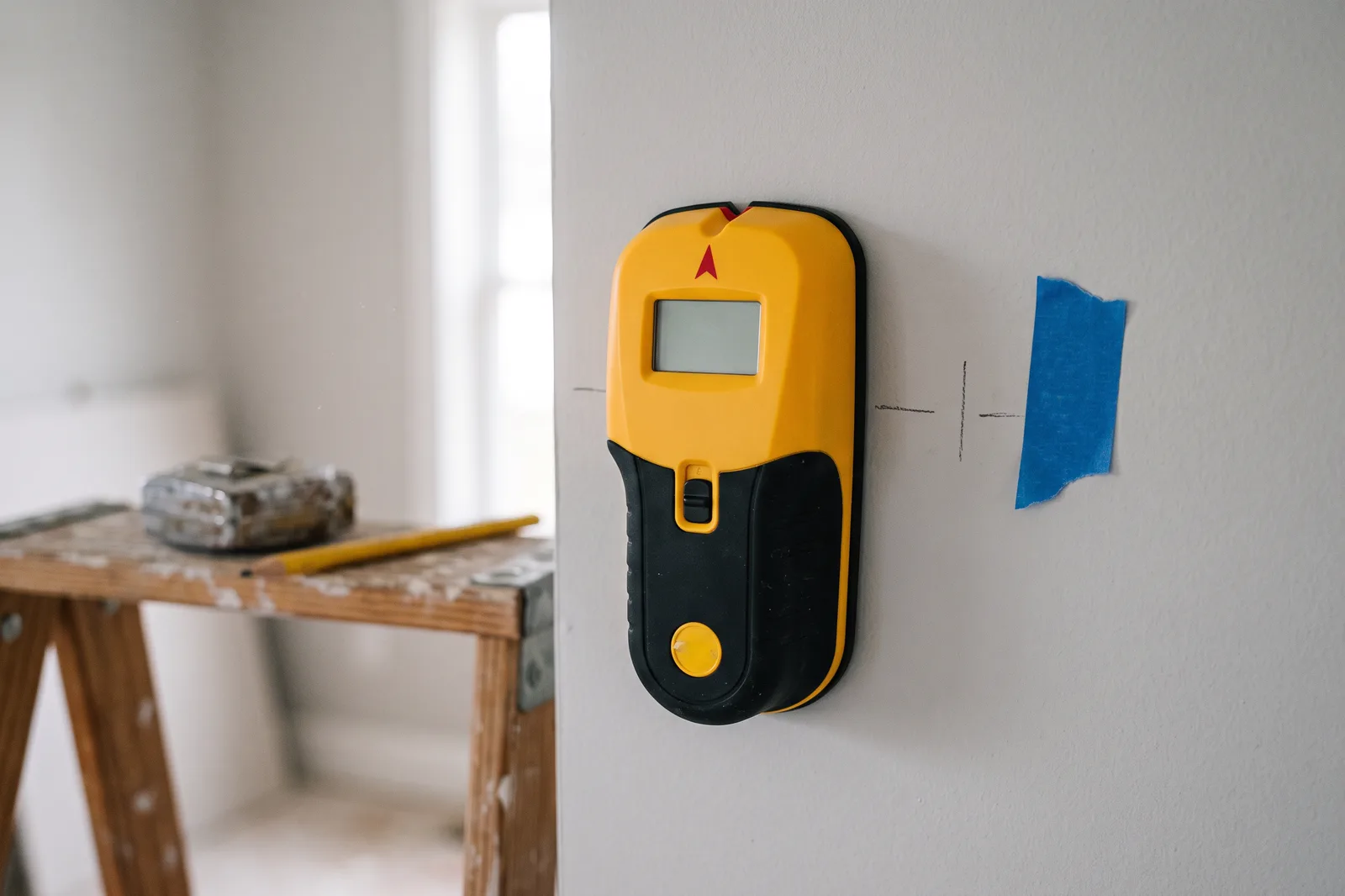 Measuring & LayoutStud Finder: The Wall Scanner That Keeps Shelves and TVs From FallingA stud finder is a small handheld scanner that tells you where the wood or metal studs are behind drywall, so heavy shelves, mirrors and TVs get fastened to something strong.
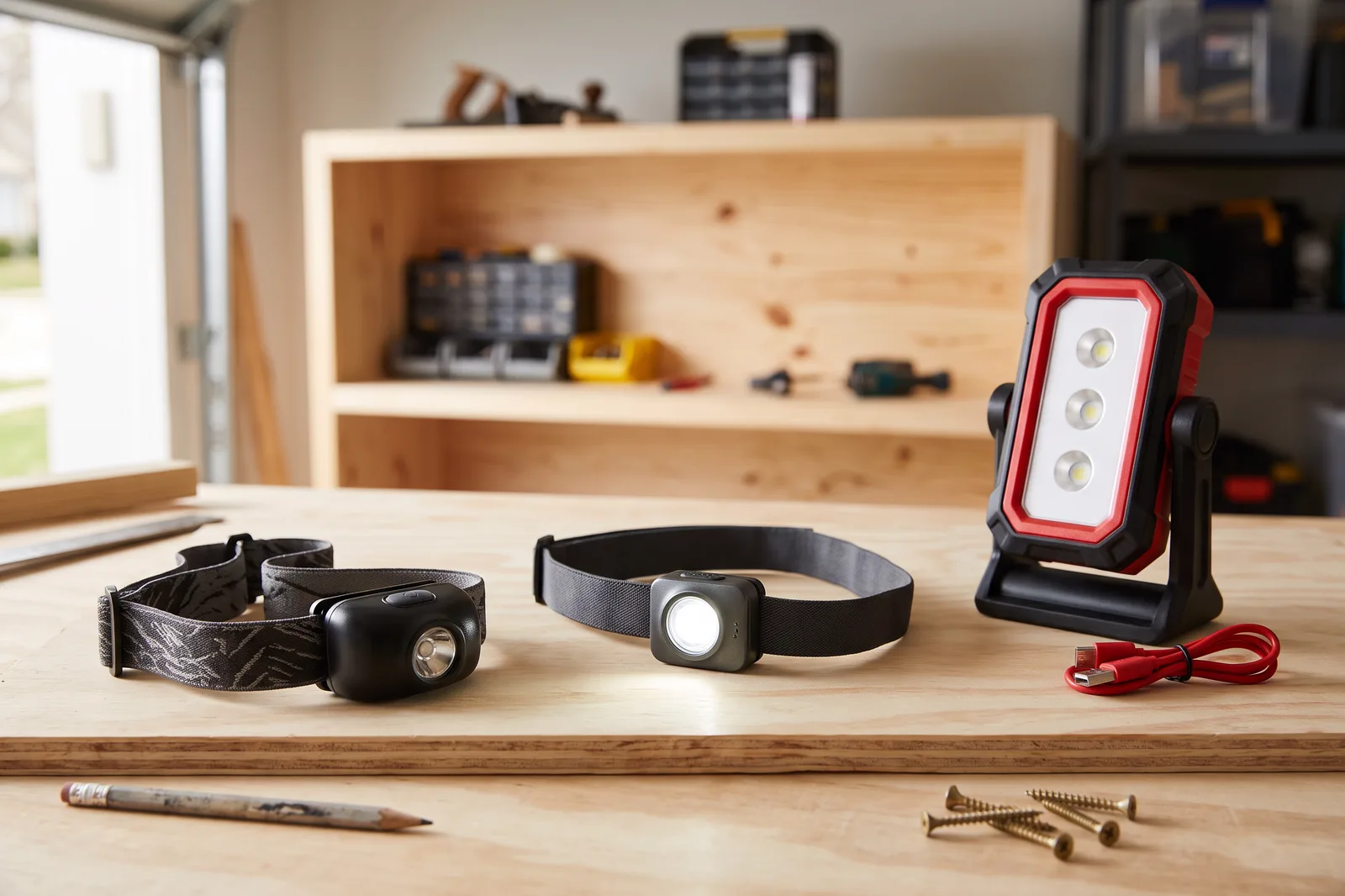 Everyday Carry & Tech · RoundupHeadlamps and Work Lights: Which Hands-Free Light to OwnA headlamp puts light where you look, so it suits attic crawls, under-sink jobs and power cuts.
 Workshop & Storage · RoundupSafety Glasses and Hearing Protection: What to Own for Home ProjectsEvery power-tool job needs two things: impact-rated eye protection and hearing protection rated for the noise.