Everyday Carry & Tech · Single tool · DIY · Pro
Phone Battery Pack: Pocket Power for the Jobsite and the Road
7 min read
As an Amazon Associate I earn from qualifying purchases. Links to Amazon on this page are affiliate links. How that works.
Quick answer
A phone battery pack, also called a power bank, is a pocket-size rechargeable battery that charges your phone through a cable when there is no outlet nearby. Anyone who spends long days on a jobsite, on the road or traveling should carry one; a 10,000mAh pack covers about two phone charges. Skip it if you are always within reach of a wall outlet or car charger.
What is a phone battery pack?
A phone battery pack is a small rechargeable battery in a hard case, about the size of a phone but thicker. You charge it at home from a wall outlet, carry it with you, and plug your phone into it with a cable when the phone runs low. People also call it a power bank or a portable charger. They are the same thing.
Inside is a lithium battery, the same kind of battery that is in your phone, plus a small circuit that controls charging so the phone gets the right amount of power. On the outside you find one or more ports (the sockets where a cable plugs in) and a few small lights that show how much charge is left.
The size of the battery is given in mAh, short for milliamp-hours. It is simply a measure of how much energy the pack holds. A typical phone has a battery somewhere around 3,000 to 5,000mAh, so a 10,000mAh pack can refill it roughly twice. Some energy is lost as heat along the way, so you never get the full number printed on the box.
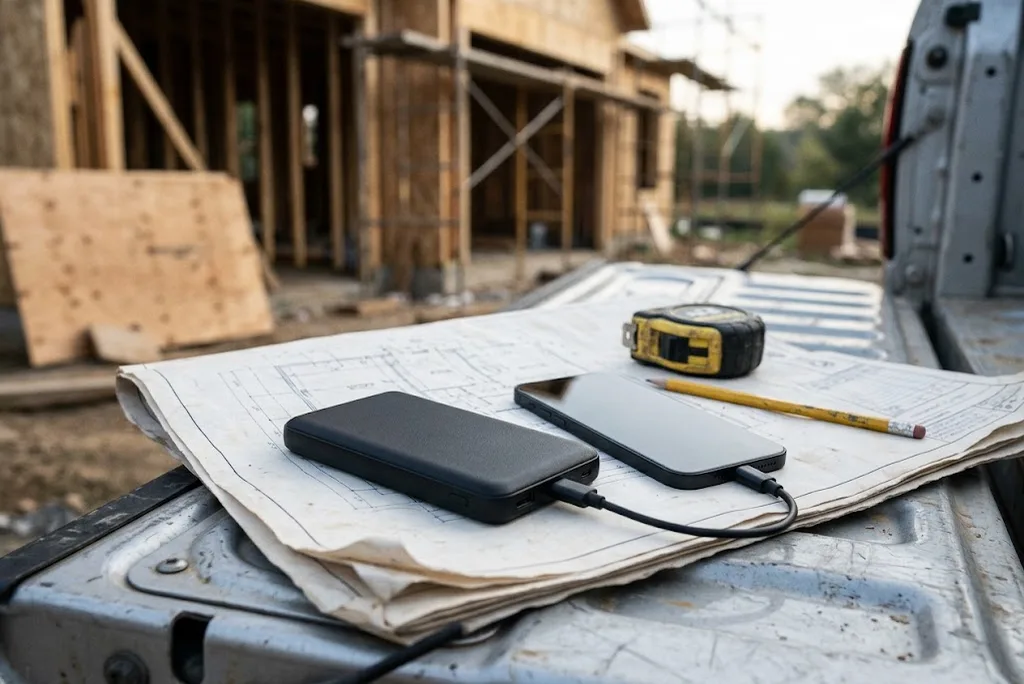
I'm a licensed architect, and a phone is now as much a site tool as a tape measure. I pull up drawings on it, photograph conditions, take calls from contractors and clients, and use the flashlight in dark crawlspaces. By mid-afternoon on a long site day, the battery is usually the first thing to quit.
Why you'll want it
A dead phone is not just an inconvenience anymore. It is your map, your boarding pass, your camera, your flashlight and the way people reach you. A battery pack is a small, inexpensive way to make sure none of that stops halfway through the day.
Long days with no outlets. Construction sites, farms, parks and parking lots rarely have a free outlet. A pack in your pocket or truck keeps the phone going until you get home.
Photos and drawings drain batteries fast. Taking dozens of site photos, recording video and keeping the screen bright in sunshine all use a lot of power. A mid-day top-up from a pack means you can keep documenting without rationing.
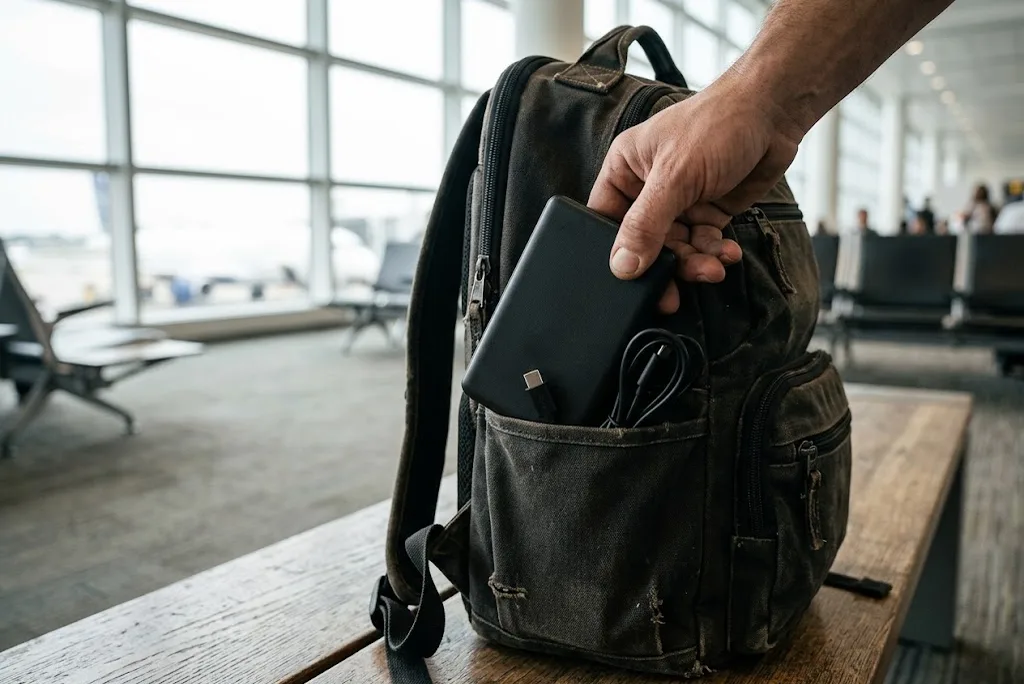
Travel days. Airports, trains and long drives are where phones die. Outlets at the gate are often taken or broken. A pack lets you charge from your seat, and it is allowed in your carry-on bag.
Storms and outages. When the power goes out, your phone becomes the way you get news and reach family. A charged pack in a kitchen drawer buys you a day or two of calls and texts.
Charging more than a phone. The same pack charges earbuds, a smartwatch, a small flashlight or a tablet in a pinch. If it charges from a USB cable, a pack can usually charge it.
Simple and quiet. There is no fuel, no noise and nothing to set up. You plug in a cable and walk away.
Where you will use one
- On the jobsite: in a vest or truck console, ready for an afternoon charge.
- On the road: in a backpack or carry-on for flights, trains and road trips.
- At home: in a kitchen drawer as part of a storm kit.
- At games and outdoors: long tournaments, hikes, fishing trips and campouts.
- In the car: a backup for when the car charger or cable fails.
How big a pack do you need?
For most people, about 10,000mAh is the sweet spot: around two phone charges in a size that still fits a jacket pocket. Larger packs, around 20,000mAh and up, carry more but are noticeably heavier and tend to stay in a bag. Small 5,000mAh packs are light but give you only about one charge. Start with the 10,000mAh size and go bigger only if you regularly charge a tablet or several devices at once.
Who it's for
- Builders, trades and inspectors who spend all day on sites with no outlets
- Travelers and commuters who rely on the phone for tickets, maps and calls
- Homeowners who want a backup for storms and power outages
- Parents and outdoor people at long games, hikes and campouts
Who should skip it
- People who are always near an outlet. If you work at a desk and drive with a car charger, a pack will mostly sit unused.
- Anyone who needs to run laptops or power tools. A small phone pack is the wrong tool; look at a larger laptop power bank or a portable power station instead.
How to use it
Using a battery pack is simple, but a few habits make it charge faster, last longer and stay safe.
- Charge the pack fully before you need it. Plug the pack into a wall charger with its cable the night before a trip or workday. Wait until all the indicator lights show full.
- Check the charge level before you leave. Press the button or look at the lights. A pack you forgot to charge is just extra weight.
- Use a good cable. Connect the pack to your phone with a cable rated for your phone. A cheap or frayed cable can charge slowly or not at all.
- Plug in the phone. Connect the cable to the pack's output port and then to the phone. Most packs start charging on their own; some need a press of the button.
- Keep both out of the heat. Charge in the shade, never on a sunny dashboard or under a pillow. Heat is the main enemy of lithium batteries.
- Unplug when the phone is full. Modern phones stop drawing power when full, but unplugging saves the pack's charge for later in the day.
- Recharge the pack after use. When you get home, plug the pack back in so it is ready for next time.
- Top up stored packs every month or two. A pack sitting in a drawer slowly loses charge. Recharge it on a schedule so it is ready for an outage.
- Retire a damaged pack. If a pack swells, cracks, gets unusually hot or smells odd, stop using it and take it to a battery recycling drop-off. Do not throw lithium batteries in household trash.
Tips from the field
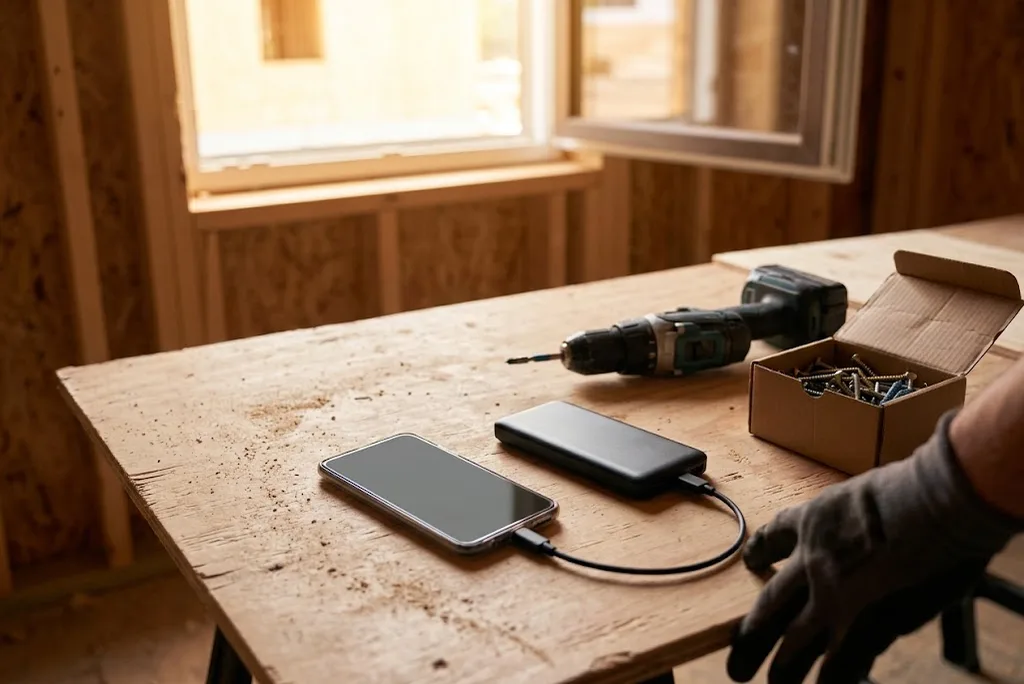
- Pair it with a short cable. A short USB-C cable lets you charge with the phone and pack in the same pocket without a tangle.
- Keep it out of the toolbox. Loose screws, nails and metal tools can scratch or puncture a pack. Give it its own pocket or pouch.
- Charge during breaks, not at the last minute. A phone at 40 percent charges faster and more efficiently than one that has already died.
- Turn down the screen. Lower brightness and close unused apps on long days. The pack lasts longer when the phone needs less.
- Label it. On a shared jobsite or at home with kids, a strip of tape with your name keeps your pack from walking away.
Common mistakes
- Buying the biggest pack you can find. Huge packs are heavy and end up left at home. The right size is the one you carry.
- Putting it in checked luggage. Airlines require power banks in carry-on bags. A pack in a checked bag can be pulled out by security.
- Leaving it in a hot car all summer. High heat shortens a lithium battery's life and can be unsafe. Bring it inside.
- Using a no-name pack with no safety marks. Unknown, uncertified packs are where most battery problems start.
What to look for when buying
Battery packs all look alike, so the details on the label matter. Here is what I check.
Capacity. Around 10,000mAh suits most people. Remember that you get roughly two thirds of the printed number in actual phone charging, because some energy is lost as heat.
USB-C. Look for at least one USB-C port. Most newer phones charge over USB-C, and a port that works both ways (it both charges the pack and charges your phone) means one cable does everything.
Charging speed. If your phone supports fast charging, a pack that supports it too will refill the phone noticeably quicker on a short break. The listing usually states the output.
Size and weight. Compare thickness and weight, not only capacity. A slim pack that slides into a pocket gets carried; a brick stays in the truck.
Build quality. A solid case and a scratch-resistant finish matter if the pack rides in a work bag. Some makers list a drop test.
Safety. Buy from an established brand and look for a safety certification mark from an independent testing lab. The pack should protect against overcharging, short circuits and overheating.
Charge indicator. Lights or a small display that show the remaining charge help you know when to top it up.
Tier. Good 10,000mAh packs from known brands sit in the budget tier, so there is no reason to gamble on an unknown brand to save a little.
The table below sums up the key specs to compare.
Key specs to look for
| Spec | What to look for |
|---|---|
| Capacity (mAh) | Around 10,000mAh gives most people about two phone charges and stays pocket-size. Go larger only if you charge a tablet or several devices, and accept the extra weight. |
| Ports | At least one USB-C port. A port that works both ways (charges the pack and charges the phone) means you carry one cable instead of two. |
| Charging speed | Support for fast charging over USB-C if your phone uses it. Faster output matters most on short breaks when you only have a few minutes. |
| Size and weight | Something you will actually carry. A pack that stays home in a drawer helps no one. Compare thickness and weight, not only capacity. |
| Build | A solid case with a scratch-resistant finish. On a jobsite, look for a stated drop test or a rubberized cover. |
| Safety certification | A recognized safety mark from an independent testing lab on the label or listing, plus protection against overcharging and overheating. |
| Charge indicator | Lights or a small display that show how much charge is left, so you know before you leave whether it needs topping up. |
| Warranty | A clear warranty from a brand with real customer support. Batteries are a part where you want someone to answer the phone. |
Where to get it
For this guide I'm featuring the Anker 10,000mAh PowerIQ USB-C battery pack. According to the product listing, it measures about 5.99 by 2.81 by 0.61 inches and weighs about 8.6 ounces, and its single USB-C port both charges the pack and charges your phone. The listing says it gives about two charges for a recent iPhone, has a case built for scratch resistance and passed a drop test of about 3.2 feet, and comes with a USB-C to USB-C cable. Anker is one of the most widely known makers of phone chargers, and this pack sits in the budget tier.
Anker Power Bank, 10,000mAh Portable Charger, PowerIQ USB-C Battery Pack
- A 10,000mAh capacity that covers about two full phone charges in a size that fits a jacket pocket
- One USB-C port that both charges the pack and charges your phone, so one cable does both jobs
- Made by a well-known charger brand with a drop-tested case, according to the product listing
How we scored it
Usefulness 9/10 · Value 9/10 · Durability 8/10. This is our own opinion, based on reading specs and using similar tools. It is not an Amazon or customer rating.
Click through to check today's price and read the current reviews on Amazon. If your phone uses an older Lightning port, add a USB-C to Lightning cable to your order.
A battery pack fits right into a small everyday carry kit alongside a flashlight and a good pocket tool. For measuring on site, see my guide to the laser distance meter, and for a full starter set, see the new homeowner toolkit.
Frequently asked questions
How many phone charges does a 10,000mAh battery pack give?
Usually about two full charges for a typical smartphone. Some energy is lost as heat while charging, so you never get the full number printed on the pack.
Can I take a phone battery pack on a plane?
In the United States, power banks must go in your carry-on bag, not checked luggage. Common sizes like 10,000mAh are well within the usual airline limits, but check your airline's rules before you fly.
Is it bad to leave my phone charging from a battery pack?
No. Modern phones and packs stop charging when the phone is full. Keep both out of direct sun and off hot dashboards while charging.
How long does a battery pack hold its charge?
A charged pack slowly loses power while it sits. Top it up every month or two if you keep it as a backup, and before any trip or long workday.
What is the difference between mAh and watt-hours?
Both describe how much energy a battery holds. mAh is the common number on phone packs; watt-hours is the number airlines use. Many packs list both on the label.
How long does a battery pack last before it wears out?
Most packs keep working well for a few years of regular use. When a pack starts to run down much faster than it used to, or swells, gets hot or is damaged, stop using it and recycle it.