
Measuring & Layout · Single tool · DIY · Pro
Moisture Meter: The Pin Tester That Finds Damp Walls and Wet Wood

Our verdict
General Tools MMD4E Pin-Type Digital Moisture Meter
7.3/10
Worth-owning score
Price tier Mid ($$)
View on AmazonOur own score from specs, buyer reviews and tests. Not a customer rating. Photo from the Amazon listing.
Quick answer
A moisture meter shows how wet wood or a wall is, so you can find a hidden leak or check lumber before you build. A pin-type model like the General Tools MMD4E is a well-reviewed, simple first meter for wood and drywall. Skip it if you want to scan whole walls without leaving pin holes; a pinless meter suits that better.
What is a moisture meter?
A moisture meter is a handheld gauge that tells you how wet wood or a wall is. A pin-type meter has two short metal pins on top. You press them into the surface, and the meter sends a tiny electrical current between them. Water carries current better than dry material, so a wetter spot gives a higher reading.
Wagner Meters and Delmhorst, two makers of these gauges, describe it the same way: the meter reads resistance between the pins, and lower resistance means more moisture. Most homeowner models show the result as a percentage on a small screen.
| Pin-type meter | Pinless meter | Thermal camera | |
|---|---|---|---|
| How it reads | Two pins pushed into the surface | A flat sensor pressed on the surface | Surface temperature, shown as colors |
| Best at | One spot, inside a board's thickness | Fast scanning of large areas | Finding a suspect patch |
| Leaves marks | Two small holes | None | None |
| Weakness | Slow over large areas; pins bend | Reads a wider area, less exact at one point | Shows temperature, not water |
Why you'll want one
It finds trouble you cannot see. Water damage is among the most common homeowner insurance claims, and it often hides behind drywall. A meter helps you follow a stain to its source, as the Unmatched Value reviewer did when tracing a leak on an RV wall.
It checks wood before you build. Wet lumber shrinks, warps and splits as it dries. Woodworking guides suggest roughly 6 to 8 percent moisture for indoor furniture, so a quick check beats guessing.
It helps you decide whether a problem is old or new. A reading well above a dry spot nearby suggests moisture is still present. A stained patch that reads like the dry area around it suggests the leak may have been fixed.
It is cheap insurance for buyers and renters. Run it along the wall under a window, around a tub or behind a toilet before you commit to a house or move in.
Common home jobs
- A brown ceiling or wall stain: trace the damp area and the edges of the wet patch.
- A musty basement or closet: compare readings on the wall, baseboard and floor.
- Around tubs, showers and sinks: check wall and floor next to the plumbing.
- Firewood and lumber: check a split log or board before burning or building.
- Before installing a wood floor or deck: confirm the boards have settled in the space.
Who it's for
- First-time homeowners chasing a water stain, a musty closet or a damp basement wall
- Woodworkers and firewood users who want to know whether lumber is dry enough to use
- Buyers and renters checking walls and floors around a tub, sink or window for hidden leaks
- DIYers planning a floor or deck who want to check wood before installing it
Who should skip it
- Anyone who needs to scan whole walls fast without holes. A pinless meter reads through the surface and is quicker over large areas.
- Pros who need lab-grade numbers for a report. Home models give a guide, not a certified reading; drywall and concrete numbers are relative.
- Finished furniture and visible trim. The pins leave two small holes.
How to use it
Use the meter to compare spots, not to diagnose by itself. Always check a known dry spot first so you have something to compare with.
- Install the battery and pick the mode. The MMD4E uses a 9V battery and has a mode button for wood or building materials, per the listing. Using the wrong scale gives a wrong number.
- Test on a dry spot first. Read a part of the same wall or board that you know is dry. That is your baseline.
- Remove the pin cap. Pull the protective cap off and keep it for storage.
- Push the pins straight in. Press them in until they are firmly seated. The listing says the pins are 8 mm, so you are reading only that shallow depth.
- Hold steady and read the screen. Wait for the number to settle. The MMD4E also has a hold button that freezes the reading, per the listing.
- Take several readings. Test every few inches, moving toward the stain. Follow the numbers up, as the video reviewer did on the RV wall, to find the wettest spot.
- Compare the numbers. On wood, compare with the 6 to 8 percent range for indoor use. On drywall, compare with the dry baseline, because those numbers are relative.
- Check the pin holes. The pins leave two tiny holes. Choose spots that will be hidden or easy to patch.
- Do not test over surface water. Wipe off condensation or standing water first, because surface wetness skews the reading.
- Store it with the cap on. The pins are the fragile part, so keep the cap in place between jobs.
What the numbers mean
No single number fits every job. Use these ranges from the sources we read as a starting point, then compare with a dry spot nearby.
| Material | Reading to expect | Where it comes from |
|---|---|---|
| Indoor furniture wood | About 6 to 8 percent | Woodworking guides |
| Construction lumber | Roughly 8 to 15 percent, depending on local humidity | One woodworking guide |
| Wall or floor in a healthy home | About 6 to 9 percent | The Ask This Old House video |
| Drywall or concrete | No fixed number; compare with a dry area | Lignomat and other meter makers |
A reading far above these ranges, or far above the dry baseline, is a reason to look for the source of the water. It is not proof of mold or rot, so for a big, spreading or recurring problem, bring in a pro.
Where pin holes are fine and where they are not
The two pins leave small holes. That is fine in a stud, a subfloor, the back of a board, the inside of a closet or behind a baseboard. It is a poor choice on a finished tabletop, visible trim or a painted wall you do not want to patch. For those jobs, read the end grain or a hidden face, or use a pinless meter instead.
Mistakes that give wrong readings
| Mistake | What happens | Fix |
|---|---|---|
| Wrong mode for the material | The number is off | Set wood or building-material mode before you read |
| No dry baseline | You cannot tell what is high | Read a dry area of the same material first |
| Testing wet or sweating surfaces | Reading is too high | Wipe the surface dry first |
| Bent pins | Poor contact and odd numbers | Straighten gently or swap in spare pins |
| Trusting one reading | A single spot can mislead | Take several readings in a line |
What reviewers and buyers say about the General Tools MMD4E
We feature the General Tools MMD4E. Here is what we found:
- Praised: Roundups name it often as a good pin-type pick for homeowners. A video tester said it tracked small moisture changes well, from 0 percent far from a wet patch up to 23 percent at its center, and that he followed the readings to find an RV wall leak.
- Common complaints: The same video says the pins are fragile and bend easily, though replacements are sold. A reviewer on one retailer page reported that part of the display stopped working after a use, and the listings we saw disagree on some specs such as accuracy. Check the Amazon page for the current spec.
- Independent tests: We did not find a lab-style, independent test of this model. Pin-meter accuracy on drywall is not well established, because drywall does not have a true moisture percentage. Treat the numbers as relative.
- Seller caution: One buying guide says to confirm the seller is General Tools or Amazon itself, since counterfeit stock has been reported in this category.
What to look for when buying
- Pin or pinless. Pins read one spot and leave holes. Pinless scans more area. Home-inspector guides say many inspectors carry both and use pinless to find the spot and pins to confirm it.
- Material modes. A wood scale and a building-material scale cover both jobs. Drywall and concrete numbers are relative.
- Measurement range. The MMD4E covers 5 to 50 percent in wood and 1.5 to 33 percent in building materials, per the listing.
- Replaceable pins. Pins bend. Buy a meter with spares or sold replacements.
- A backlit screen. It helps in crawlspaces, closets and basements.
- Alerts and hold. Low / mid / high lights and a hold button let you read in tight spots.
- A calibration check. A simple check on the pin cap, as the MMD4E has, shows if the meter has drifted.
- A trustworthy seller. Buy from the maker or Amazon itself.
- Pair it with other tools. A stud finder tells you what is in the wall before you push pins into it, and a multimeter and voltage tester is the tool for live wires, which a moisture meter is not. An infrared thermometer can show a cold patch on a wall worth checking with the pins.
Key specs to look for
| Spec | What to look for |
|---|---|
| Type | Pin-type: two metal pins push into the material and the meter reads electrical resistance. Pinless meters scan the surface instead. |
| Wood range | 5 to 50 percent on the MMD4E, per the listing. Woodworking guides aim for roughly 6 to 8 percent for indoor furniture. |
| Building-material range | 1.5 to 33 percent on the MMD4E for drywall and concrete, per the listing. These readings are relative, not a true moisture percentage. |
| Modes | A switch between a wood scale and a building-material scale. The meter reads wrong if the mode does not match the material. |
| Display and alerts | A backlit screen and LOW / MID / HIGH lights make dim crawlspaces and closets easier. The MMD4E has both, per the listing. |
| Pins | Replaceable pins. The listing says spare 8 mm stainless pins come in the box; a video tester warned they bend easily. |
| Calibration check | The MMD4E's pin cap doubles as a calibration checker, per the listing. It is a quick check, not a lab calibration. |
| Power | A 9V battery on the MMD4E, per the listing, which comes included. |
Where to get it
Our featured pick is below, chosen from buyer feedback and the reviews we found. For a cleanup after a leak, see our shop vacuum guide.

General Tools MMD4E Pin-Type Digital Moisture Meter
- Reads 5 to 50 percent in wood and 1.5 to 33 percent in building materials such as drywall and concrete, with a wood/building-material mode button, according to the listing
- Backlit LCD with LOW / MID / HIGH lights, a hold button, spare 8 mm stainless pins and a pin cap that doubles as a calibration check, per the listing
- One video tester found it tracked small changes in moisture well on soaked cardboard and an RV wall, but said the pins bend easily
How we scored it
Usefulness 8/10 · Value 8/10 · Durability 6/10. This is our own opinion, based on specs, buyer reviews and independent tests. It is not an Amazon or customer rating.
Watch and read more
Video reviews
- General Tools MMD4E Digital Moisture Meter Testing And Review — Unmatched Value
Unboxes the MMD4E, tests it on soaked cardboard and a leaking RV wall, finds it tracks small changes up to 50 percent, and warns the pins bend easily. - How to Use a Moisture Meter | Ask This Old House — This Old House
Explains thermal camera, pinless and pin meters for finding water in walls, and says a reading of about 6 to 9 percent is a healthy range. - Pin vs. Pinless Moisture Meters - Know the Differences — WagnerMeters
A pinless-meter maker explains how pin meters measure resistance, why they leave holes and why it favors pinless; read it as a maker's view.
Free calculators FigureMyHome
- Drywall Calculator — If a wet patch means replacing a panel, work out how many sheets you need.
Frequently asked questions
What does a moisture meter measure?
On wood, it estimates how much of the board's weight is water. On drywall and concrete the number is only relative, so use it to compare a suspect spot with a known dry spot.
How does a pin-type moisture meter work?
Two metal pins push into the material, and the meter measures electrical resistance between them. Wetter material conducts better, so the reading rises as moisture increases, as the meter makers Wagner and Delmhorst explain.
What reading is dry wood?
It depends on the use. Woodworking guides suggest about 6 to 8 percent for indoor furniture after the wood has settled in the room. Lumber for building is often drier or wetter depending on the climate where you live.
Can a moisture meter find a leak behind drywall?
It can point to one. In the This Old House video, an energy-assessment pro first finds a cold or wet-looking patch with a thermal camera, then confirms the damp spot with a moisture meter. A reading well above the nearby dry area suggests a problem.
Pin or pinless: which should I buy?
Pin meters read at the pin tips, so they are good for checking one spot or inside a board's thickness, and they leave small holes. Pinless meters scan a larger area without damage. Home-inspector guides say many inspectors carry both.
Do I need to set the wood species?
Wood species changes the reading slightly, and some meters have a species or correction setting. The MMD4E listing offers a simple wood and building-material mode, so treat wood readings as a close guide.
How do I keep the pins from bending?
Push them in straight, keep the cap on when stored and do not pry. One video tester said the MMD4E pins bent after light use, and spare pins are sold.
Sources
Related tools
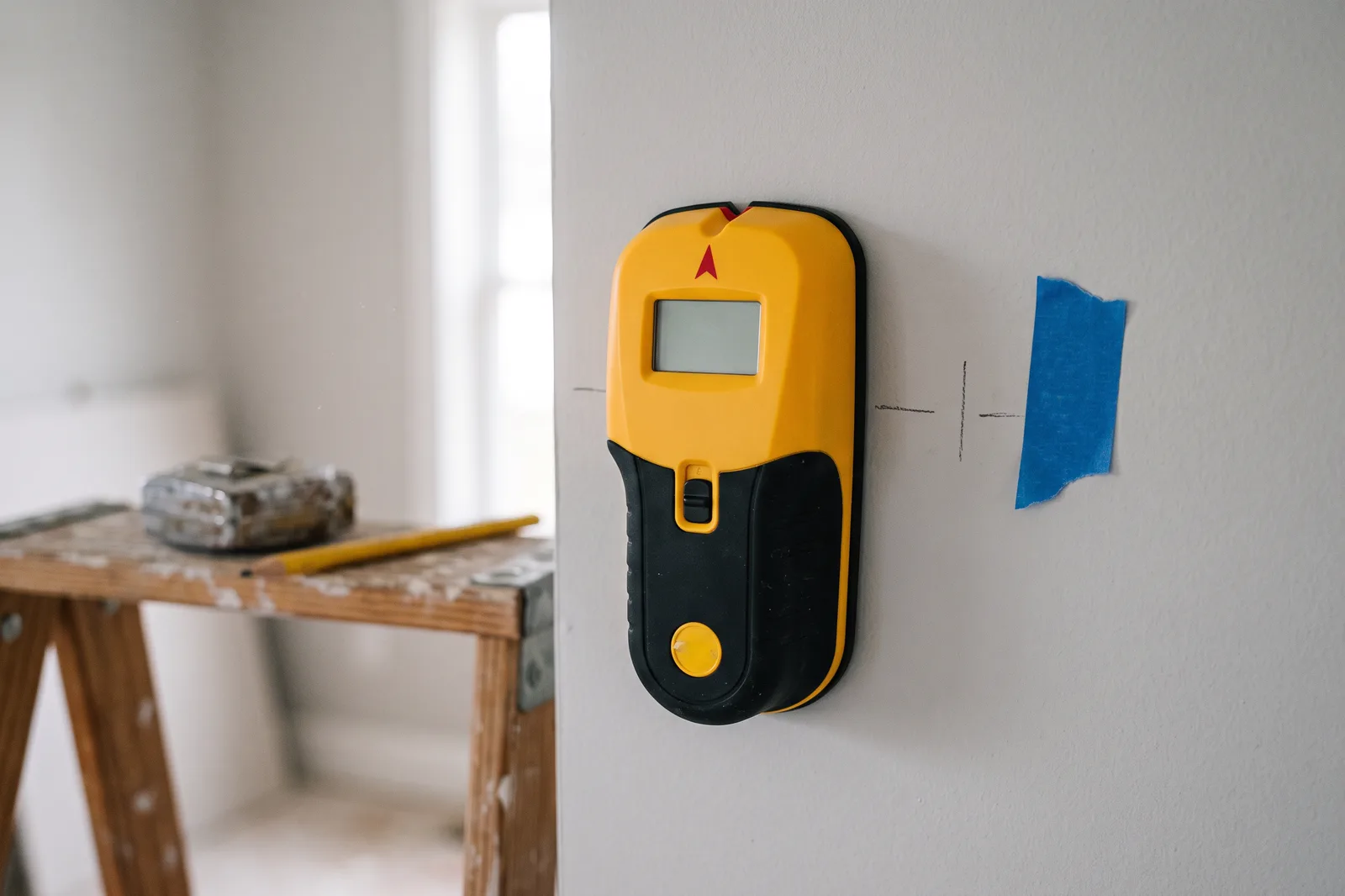 Measuring & LayoutStud Finder: The Wall Scanner That Keeps Shelves and TVs From FallingA stud finder is a small handheld scanner that tells you where the wood or metal studs are behind drywall, so heavy shelves, mirrors and TVs get fastened to something strong.
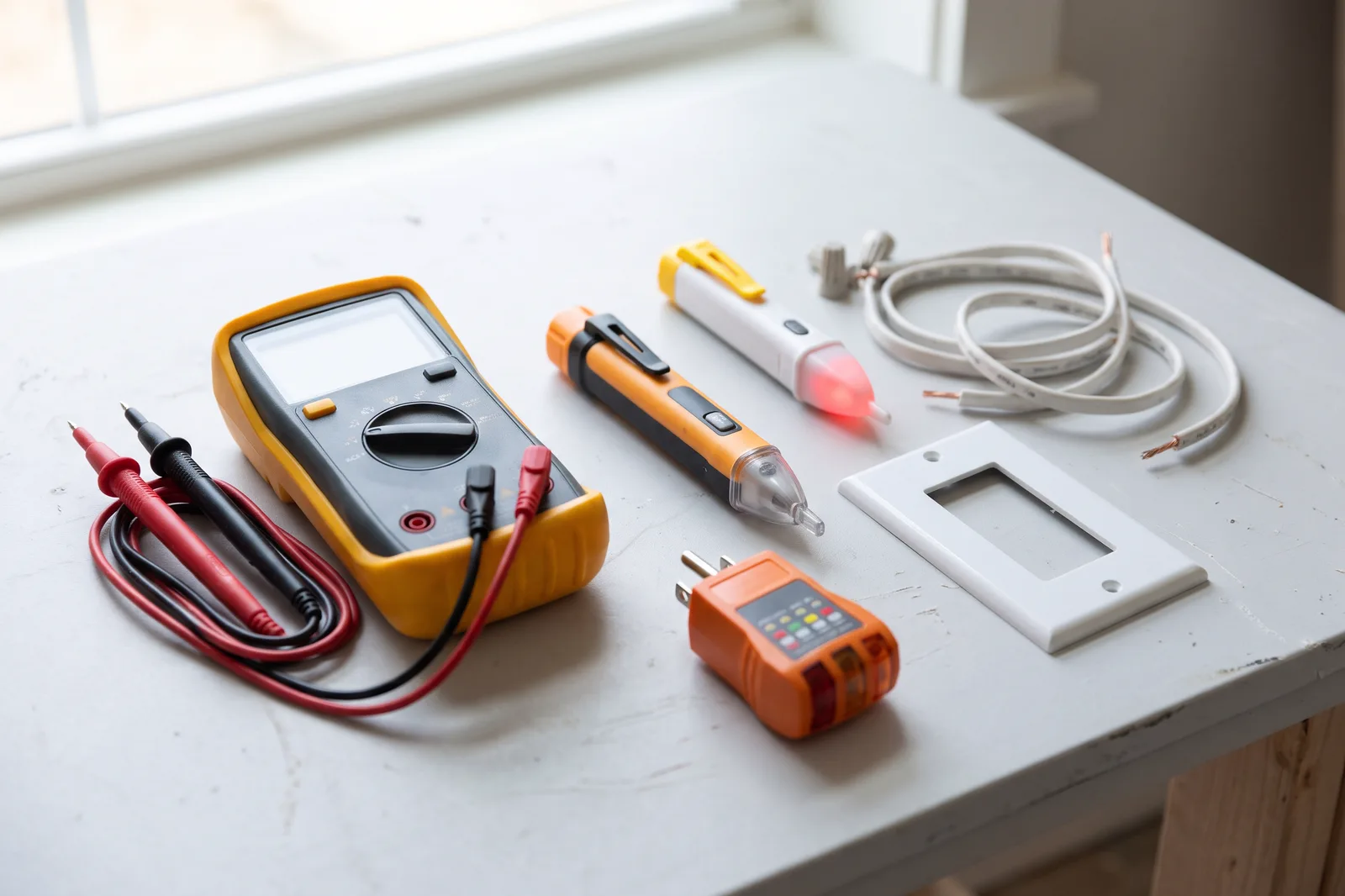 Measuring & Layout · RoundupMultimeters and Voltage Testers: Which to Own at HomeA non-contact voltage pen tells you if a wire may be live, a plug-in outlet tester checks wiring on the spot, and a multimeter gives actual numbers.
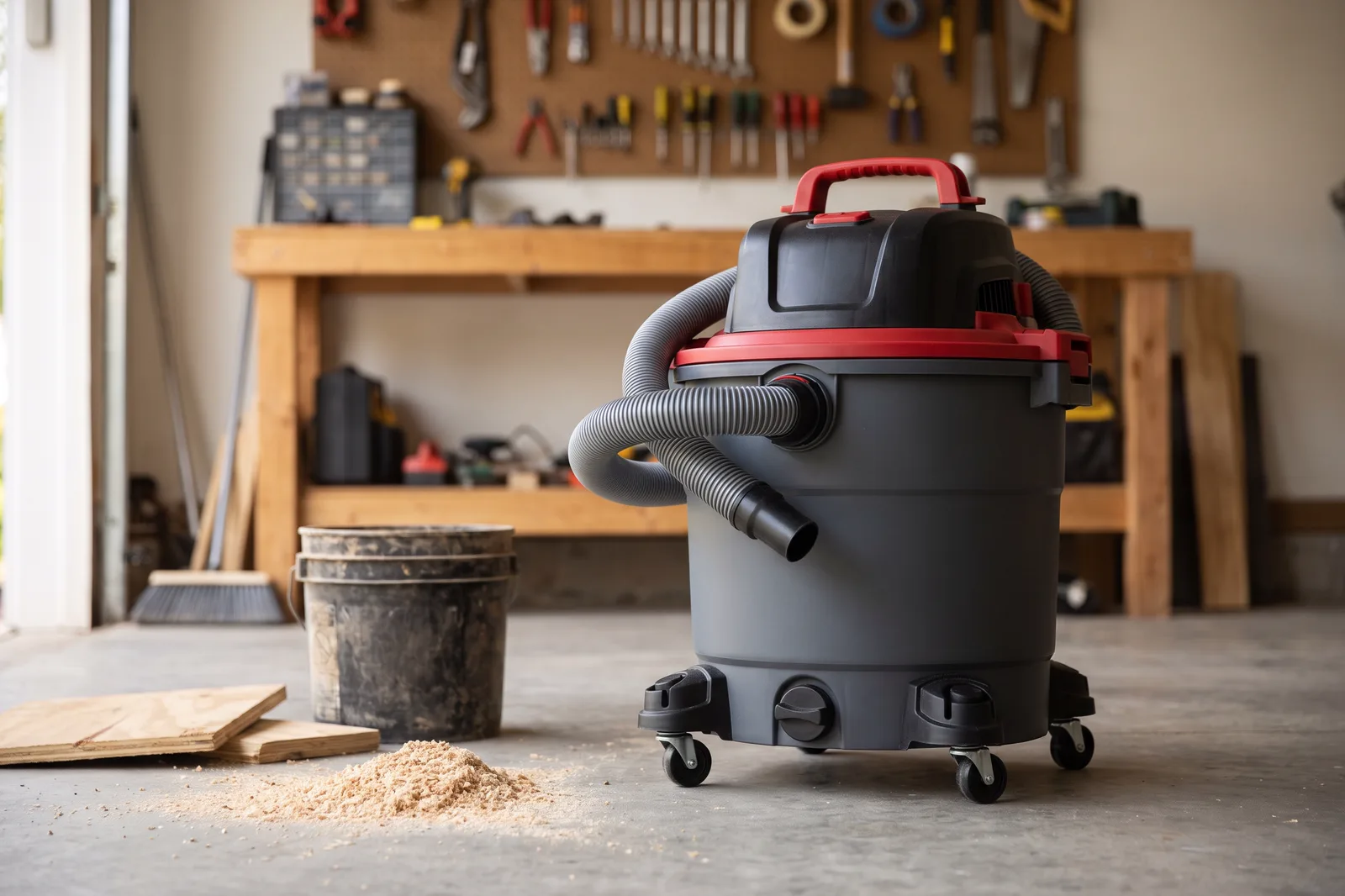 Workshop & StorageShop Vacuum: The Wet/Dry Cleanup Tool Every Garage NeedsA shop vacuum is a tough wet/dry vacuum that sucks up sawdust, drywall scraps and spilled water that would wreck a household vacuum.