
Measuring & Layout · Roundup · DIY · Pro
Marking Pens and Pencils for Layout: The 5 Types Worth Owning
Quick answer
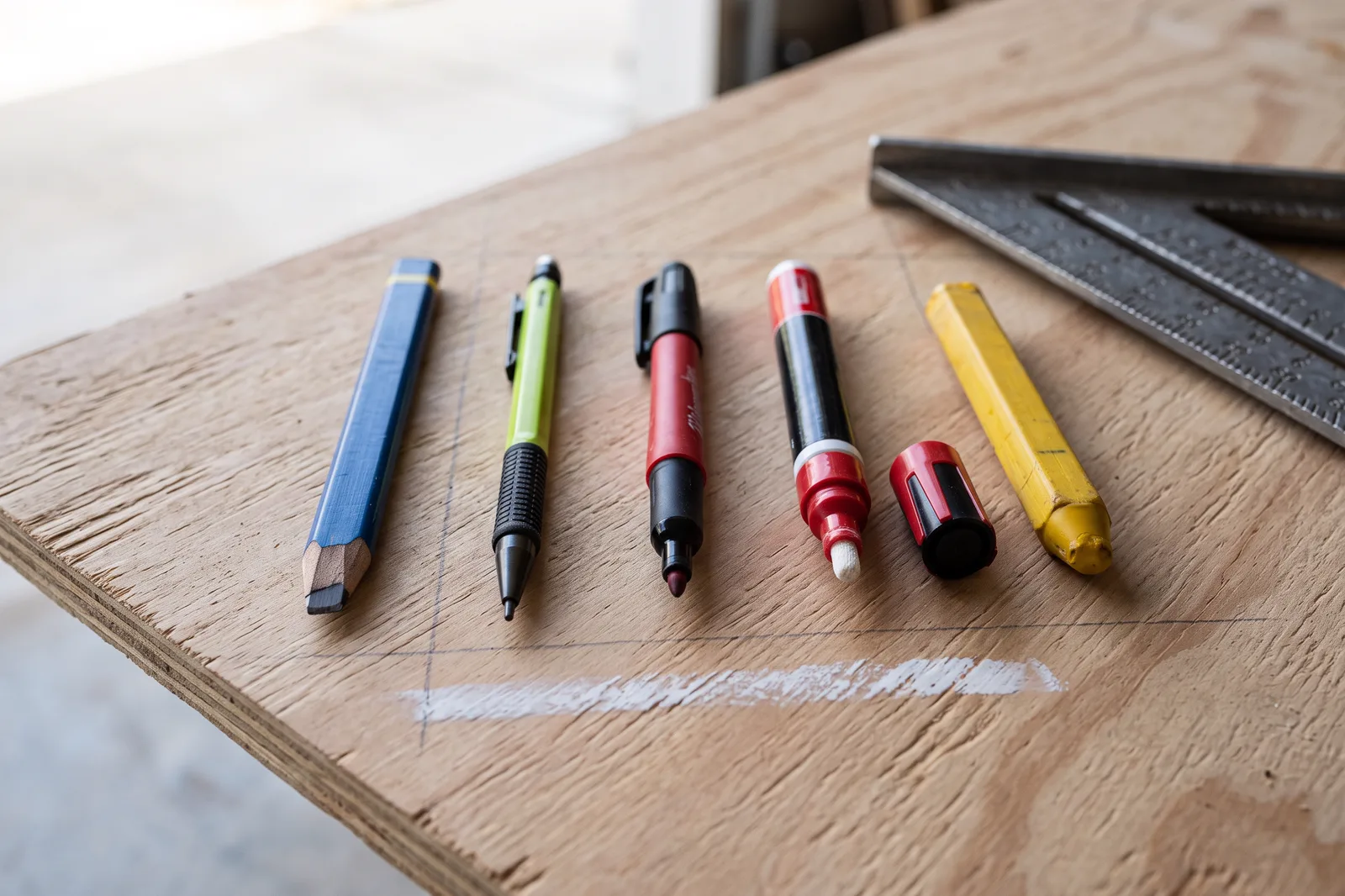
Keep a flat carpenter pencil for everyday lines on clean wood, a refillable construction pencil like the Pica-Dry for tight spots and damp surfaces, and a fine jobsite marker for dark lines on rough or dusty material. Add a paint marker for concrete and metal, and a lumber crayon for wet or pitchy boards. Most homeowners only need the first three.
What are the layout markers worth owning?
A layout marker is anything you use to draw a line you will cut, drill or build to. The right one gives you a line you can see, that stays where you put it and that comes off if you need it to. The wrong one skips on rough wood, smears on dust or vanishes on a wet board.
Five types cover almost every job:
| Marker | What it does best | Line | Comes off? |
|---|---|---|---|
| Flat carpenter pencil | Everyday lines on clean wood | Thin when sharp, bold when flat | Sands off |
| Refillable construction pencil | Tight spots, holes, damp and mixed surfaces | Fine to medium | Wipes or sands off, depending on refill |
| Fine jobsite marker | Dark, readable lines on rough or dusty material | Medium | Sands off slowly |
| Paint marker | Concrete, steel, asphalt and dark surfaces | Bold | Stays |
| Lumber crayon | Wet, pitchy and weathered boards | Very bold | Stays |
We picked one well-reviewed model of each: the IRWIN carpenter pencil, the Pica-Dry 3030, the Milwaukee INKZALL fine point marker, the Milwaukee INKZALL white paint marker and the DIXON lumber crayon. We chose them from the makers' listings, a framer's field test and a Pro Tool Reviews test of the INKZALL, ToolGuyd's INKZALL versus Sharpie comparison and four YouTube reviews whose captions we checked. If you are doing precise joinery instead of layout, start with our guide to marking tools for woodworking.
The five types in more detail
Flat carpenter pencil. The classic. The flat or oval body will not roll off a sloped roof or a sawhorse, and the wide lead can be sharpened to a chisel edge for a thin line or used flat for a bold one. The IRWIN listing describes a broad lead that makes fine lines for detail or coarse lines on rough surfaces. The trade-off is upkeep: you need a knife or sharpener, and graphite does not show on dark or wet surfaces. The weak spot is the surface, not the brand.
Refillable construction pencil. The Pica-Dry is a mechanical pencil with a sheath that protects the tip, a clip and a sharpener built into the cap. The Silver Cymbal review shows its lead marking tile, galvanized steel, aluminum and copper, and shows a wax refill for concrete and brick. A slim tip also fits through a drilled hole, which a regular marker cannot do. Skill Builder's two tradesmen like the big lead that never needs sharpening, and one of them notes that a pencil that gets wet can stop gripping the lead until it dries and is cleaned. The listing graphics show a 2.8 mm lead.
Fine jobsite marker. A felt-tip marker with a tip made for rough materials. A framer who tested the INKZALL medium point for about three months says the line is only a little thicker than a pencil line but dark enough to read from a distance. His complaints: the tip wears down on OSB and the marker does not write on wet wood. Pro Tool Reviews scored the INKZALL highest on rough and dusty marking and lowest on wet marking and abrasion. ToolGuyd's writer buys both INKZALL and Sharpie and says the INKZALL tips seem a little more durable, while the Sharpie costs less.
Paint marker. A valve-action marker with liquid paint and an acrylic nib. White paint shows up on dark steel, asphalt and gray concrete, where black ink and graphite disappear. The maker says the paint dries in about ten seconds, marks surfaces up to 300°F and resists water and UV light. A paint marker is permanent, so use it where the mark does not matter or will be covered.
Lumber crayon. A hex-shaped wax stick. Wax sticks to damp and pitchy lumber where a pencil skips and a felt tip smears. The DIXON listing says the marks will not smear, fade, melt or wash away. A roundup from Journeyman HQ (an affiliate site, so we treat it with caution) also names crayons for wet and weathered lumber. They are too thick for fine layout, but good for marking a stack of boards or concrete forms.
Why you'll want them
A good line is the first cut. If you can't see the line, you will cut wide of it, and wood does not grow back. A line you can read from arm's length saves a whole board.
Different surfaces need different marks. Graphite grips dry wood well. It does not show on dark metal or concrete, and it smears or washes away when things get wet. Wax and paint solve those problems. A framer's field test of the INKZALL found the medium point useful for laying out wall plates because the dark line could be seen from a distance, while pencil marks on house wrap or sheathing were too faint to read across a site.
One marker rarely does it all. In Tool Craze's marker test, every marker did well on wood, but only some could write on a wet tile, and the tip that lasted longest on concrete block was a different one from the one that wrote best. The framer who tested the INKZALL also reports needing a different marker on OSB and in the rain. Most people end up with two or three.
The right marker makes tight jobs possible. A flat pencil will not reach through a drilled hole to mark the stud behind it. A slim mechanical pencil will. The Silver Cymbal review shows the Pica-Dry marking through a hole that a regular marker could not.
They are cheap. A pack of pencils or crayons costs less than a single blade for a saw. Better markers are an easy upgrade.

Who it's for
- Homeowners and DIYers who mark cut lines, stud locations and drill points on wood, drywall and masonry
- Framing and deck builders who lay out plates, joists and blocking and need marks readable from several feet away
- Tradespeople and handy renters who mark metal, tile, pipe or concrete and want one pen that works on all of it
Who should skip it
- Fine woodworkers cutting joinery. A scored line from a marking knife or gauge is thinner and more accurate. See our guide to marking tools for woodworking.
- Anyone marking a finished surface. Ink, paint and wax are hard to remove. Use painter's tape and a pencil instead.
- Anyone who only needs a mark now and then. A single carpenter pencil is enough.
How to use them
These steps follow the habits in the videos and tests we checked.
- Clean the surface first. Brush off sawdust and wipe off oil or moisture. Even a marker built for dusty surfaces writes more crisply on a clean one.
- Pick the marker for the surface. Pencil for clean dry wood, marker for rough or dusty lumber and OSB, paint or wax for concrete, metal and wet boards.
- Sharpen a flat pencil to a chisel edge. Use a knife or a sharpener. A thin edge gives a sharp line along a square. The flat side gives a bold line when speed matters.
- Mark with the tool against a straightedge. Hold the point right against a speed square or a rule. The line should touch the edge you are measuring to.
- Draw a line, then an X on the waste side. An X on the side you will cut away removes the most common layout mistake, cutting on the wrong side of the line.
- Use one mark for one cut. Two marks beside each other cause cuts on the wrong one. If you redraw, cross out the old line.
- Test a marker on a scrap first. Some markers bleed on bare wood. In On The Workbench's head-to-head test, the INKZALL bled a little more than a regular fine Sharpie on a 2x4, and its mark was harder to sand off.
- Let paint and ink dry. Ink dries in seconds. Paint usually needs a few more. The maker lists about ten seconds for the INKZALL liquid paint marker.
- Prime a paint marker before you use it. Press the tip against scrap until paint flows, and cap it after each use.
- Dry and clean a refillable pencil if it stops gripping. In the Skill Builder video, a pencil that got wet stopped gripping the lead until it dried out and the residue was blown clear.
- Cap or sheath every marker. Open ink dries out and loose tips break.
- Choose the mark that suits the job's life. If a mark will be seen on the finished piece, use pencil and sand it off. If it needs to survive rain and a weekend, use paint or crayon.
Common mistakes
- Using a felt-tip marker on wet wood. The framer who tested the INKZALL says it does not write on wet wood.
- Pressing a fine tip hard on rough sheathing. The same reviewer wore one down on OSB.
- Marking a visible face with ink. Ink and paint do not erase.

What to look for when buying
Start with the surface, not the brand. Most layout mistakes come from a marker that does not suit the material: graphite on dark metal, a felt tip on a wet board, a thick crayon on a fine cut line. Decide where you mark most often and buy for that first. For a mixed home toolbox, one flat pencil, one fine marker and one crayon or paint marker cover most of what comes up.
Match the mark to the surface. Read the maker's listing for the surfaces it claims. The INKZALL listing says its tip is made for concrete, OSB and cinder block. Retailer listings quoting the maker say the paint marker writes on very dirty, rough or hot surfaces, dries in about ten seconds and resists water and UV light. Treat these as maker claims, not independent results.
Check how the tip wears. On rough materials, tips take a beating. In Tool Craze's concrete block test, the regular Sharpie and the INKZALL wore about the same, and a Sharpie Pro chisel tip stayed in the best shape. A ToolGuyd writer who uses both says INKZALL tips seem a little more durable than Sharpie's, but cost more.
Prefer a body that clips and does not roll. A hard hat clip, pocket clip or flat body keeps a marker out of the dirt. The hex crayon and oval pencil are built for this.

Think about refills. A refillable pencil like the Pica-Dry costs more up front, but you replace the lead rather than the pencil. Refills are made in graphite, wax and other formulas, according to the Silver Cymbal review and the listing photos.
Know the limits. On Pro Tool Reviews' test the INKZALL scored best on rough and dusty surfaces, and lowest on wet marking and abrasion. Wet-lumber jobs may still need a crayon or paint.
Buy a few of each. Markers are cheap, they walk off job sites, and having a backup beats stopping mid-cut.
Key specs to look for
| Spec | What to look for |
|---|---|
| Mark type | Graphite (pencil), ink (felt-tip marker), paint (liquid marker) or wax (crayon). Graphite is easy to erase. Ink, paint and wax are meant to stay. |
| Line width | A flat carpenter pencil can be sharpened to a thin edge or used broad. A fine marker line is a little thicker than a sharp pencil line. A crayon line is thick and bold. |
| Surfaces | Clean framing lumber takes almost anything. Concrete, metal, wet wood and plastic need paint, wax or an ink the maker says writes on that surface. |
| Wet and dusty use | Check the maker's claim and treat it as a starting point. In one video test a fine marker passed a wet-laminate test that a regular permanent marker did not, but it did not mark a soaked tile well. |
| Tip durability | Rough materials like OSB and concrete block wear felt tips down. A tip made for rough surfaces lasts longer, and a replaceable tip or refill extends a tool further. |
| Sharpening | A flat pencil needs a knife or sharpener. Mechanical construction pencils skip this, and many have a sharpener in the cap. |
| Carry | A pocket clip or hard hat clip stops the marker from falling out. A flat or hex body will not roll off a slanted surface. |
Where to get them
All five are sold on Amazon. We rate the IRWIN pencils and DIXON crayons as budget tier, the INKZALL fine and paint markers as mid tier and the Pica-Dry as pro tier. Check the pack size and colour in each listing before you buy: the IRWIN set has six pencils, the INKZALL fine marker comes as four, and the crayons are sold by the dozen.
| Pick | Best for | What buyers like | What buyers flag |
|---|---|---|---|
| IRWIN carpenter pencil | Everyday lines on lumber | Flat shape does not roll, tough lead | Needs sharpening; graphite washes away when wet |
| Pica-Dry 3030 | Tight spots, holes, mixed surfaces | No sharpener needed, refill options, clip | Costs more than a flat pencil; wet pencils need cleaning |
| INKZALL fine point | Plates, studs, rough and dusty wood | Dark, readable line, hard hat clip | Tip wears on OSB; not for wet wood |
| INKZALL white paint marker | Concrete, steel, dark surfaces | Bold white line, water and UV resistant per maker | Needs priming; bold line |
| DIXON lumber crayons | Wet or pitchy lumber, framing | Cheap, will not wash away per listing | Thick line, not for precise work |

IRWIN Carpenter Pencil, Medium Lead, 6-Piece (66400)
- Oval, flat shape that will not roll off a slanted roof or a sawhorse, per the listing
- Broad lead gives fine lines or coarse lines on rough surfaces, per the listing
- Cheap enough to keep one in every bag, apron and vehicle
How we scored it
Usefulness 8/10 · Value 9/10 · Durability 7/10. This is our own opinion, based on specs, buyer reviews and independent tests. It is not an Amazon or customer rating.

Pica-Dry Longlife Automatic Pencil 3030
- Refillable mechanical pencil with a protective sheath and a sharpener built into the cap
- Slim tip reaches into drilled holes and tight corners where a flat pencil cannot
- Refills come in graphite, wax and other formulas for damp, wet or rough surfaces
How we scored it
Usefulness 9/10 · Value 8/10 · Durability 8/10. This is our own opinion, based on specs, buyer reviews and independent tests. It is not an Amazon or customer rating.

Milwaukee 48-22-3104 INKZALL Fine Point Marker, Black, 4-Pack
- Dark line that is easy to read from a distance on framing, plates and sheathing
- Tip is made for rough surfaces like OSB, cinder block and concrete, per the listing
- Hard hat clip and quick-dry ink, per the listing
How we scored it
Usefulness 8/10 · Value 8/10 · Durability 6/10. This is our own opinion, based on specs, buyer reviews and independent tests. It is not an Amazon or customer rating.

Milwaukee 48-22-3711 INKZALL Liquid Paint Marker, White
- White paint shows up on dark metal, concrete and asphalt where black ink and graphite vanish
- Acrylic nib and paint the maker says is water and UV resistant
- Valve-action design: press the tip to start the paint flowing
How we scored it
Usefulness 7/10 · Value 7/10 · Durability 8/10. This is our own opinion, based on specs, buyer reviews and independent tests. It is not an Amazon or customer rating.

DIXON Industrial Lumber Marking Crayons, Yellow, 12-Pack (X49600)
- Wax stick marks damp, dusty and pitchy boards where a pencil or marker skips
- Hex shape is easy to grip, 4.5 inches long, per the listing
- The listing says marks will not smear, fade, melt or wash away
How we scored it
Usefulness 7/10 · Value 9/10 · Durability 8/10. This is our own opinion, based on specs, buyer reviews and independent tests. It is not an Amazon or customer rating.
Before you buy, check the listing photos and pack contents, and add a feet-inch fraction calculator check to your cut list so you mark the right numbers the first time.
Watch and read more
Video reviews
- Carpenter's Pencils ~ Which Is The Best? — Skill Builder
Two tradesmen compare the pens and pencils they use: a refillable construction pencil with a big lead that does not need sharpening, tracer-style pencils with different refills for glass, wood and metal, and a note that wet pencils should be dried out and cleaned. - MOST ADVANCED DIY PENCIL in the WORLD - PICA Dry Review — Silver Cymbal
Shows the Pica-Dry marking tile, galvanized metal, aluminum and copper, going through a drilled hole, and swapping in wax refills for concrete and brick, with a note that tile lines survive tile-saw spray but wipe off with a rag. - Milwaukee Inkzall and Sharpie Pro Markers Review and Comparison — Tool Craze
Tests Milwaukee INKZALL and Sharpie markers on wood, plastic, tile, metal, dusty, wet and oily surfaces and on tip wear on concrete block: all did well on most, only some wrote on a wet tile, and the Sharpie Pro tip lasted longest.
PROSWho uses it
- Essential Craftsman (Dan Cox) — Explains which refillable pens and pencils he uses and why, including a big-lead refillable pencil that never needs sharpening.
Free calculators FigureMyHome
- Feet-Inch Fraction Calculator — Add and subtract measurements before you mark a cut list.
Frequently asked questions
What is the best way to mark lumber for cutting?
On clean, dry lumber a sharp carpenter pencil or a mechanical construction pencil gives a clear line that comes off with sandpaper. On rough, dusty or dark material a fine jobsite marker is easier to see. Measure and mark from the same edge each time.
What is a Pica-Dry and is it worth it?
It is a refillable mechanical pencil made for construction. Buyer and video feedback says its thin tip reaches into drilled holes and its refills mark damp and rough surfaces. A video reviewer says the lead and sheath resist breaking. It costs more than a flat pencil, so it suits people who mark every day or in tight spots.
Can I mark on wet wood?
Graphite washes out or will not mark wet wood. Lumber crayons and paint markers are made for it. A video test found one fine jobsite marker could write through plain water on laminate, while a regular fine marker wiped off easily, but results on a fully wet surface vary by marker and surface.
Is Milwaukee INKZALL better than a Sharpie?
It depends on the job. One tester found the INKZALL tip a little more durable on rough materials, and a framer's test found the medium point easy to read from a distance. Another video test found a regular Sharpie bled less and sanded off faster on bare wood. Many tradespeople keep both.
How do I get a permanent marker line off wood?
Sand it. In a video test, a pencil line came off with a quick pass of 80-grit sandpaper, while a Sharpie line was nearly gone and an INKZALL line was still visible. If a mark will show on the finished piece, use pencil.
Why use a flat carpenter pencil instead of a round one?
The flat or oval shape does not roll away on a slanted surface, and the wide lead can be sharpened to a chisel edge for a thin line or used flat for a bold one. Makers describe the lead as hard to snap.
How should I mark on concrete or metal?
Use a paint marker or a wax crayon. White paint shows up on dark steel and gray concrete. For fine work on metal, refills for a mechanical construction pencil are made for galvanized metal, aluminum and copper.
Sources
- JLC: Tested: Milwaukee Inkzall Jobsite Marker (search snippet; page blocked automated access)
- Pro Tool Reviews: Milwaukee Inkzall markers review
- ToolGuyd: Milwaukee Inkzall vs. Sharpie
- On The Workbench (video): Battle of the Markers, Milwaukee Inkzall vs Sharpie vs. Pencil
- Journeyman HQ: 6 best construction pencils for marking wet lumber (affiliate roundup)
- Elliott Electric: Milwaukee 48-22-3711 INKZALL white liquid paint marker (maker specs)
Related tools
 Measuring & LayoutMarking Tools for Woodworking: Pencils, Knives and Gauges ComparedUse a pencil for rough layout and a marking knife or gauge for anything that has to fit.
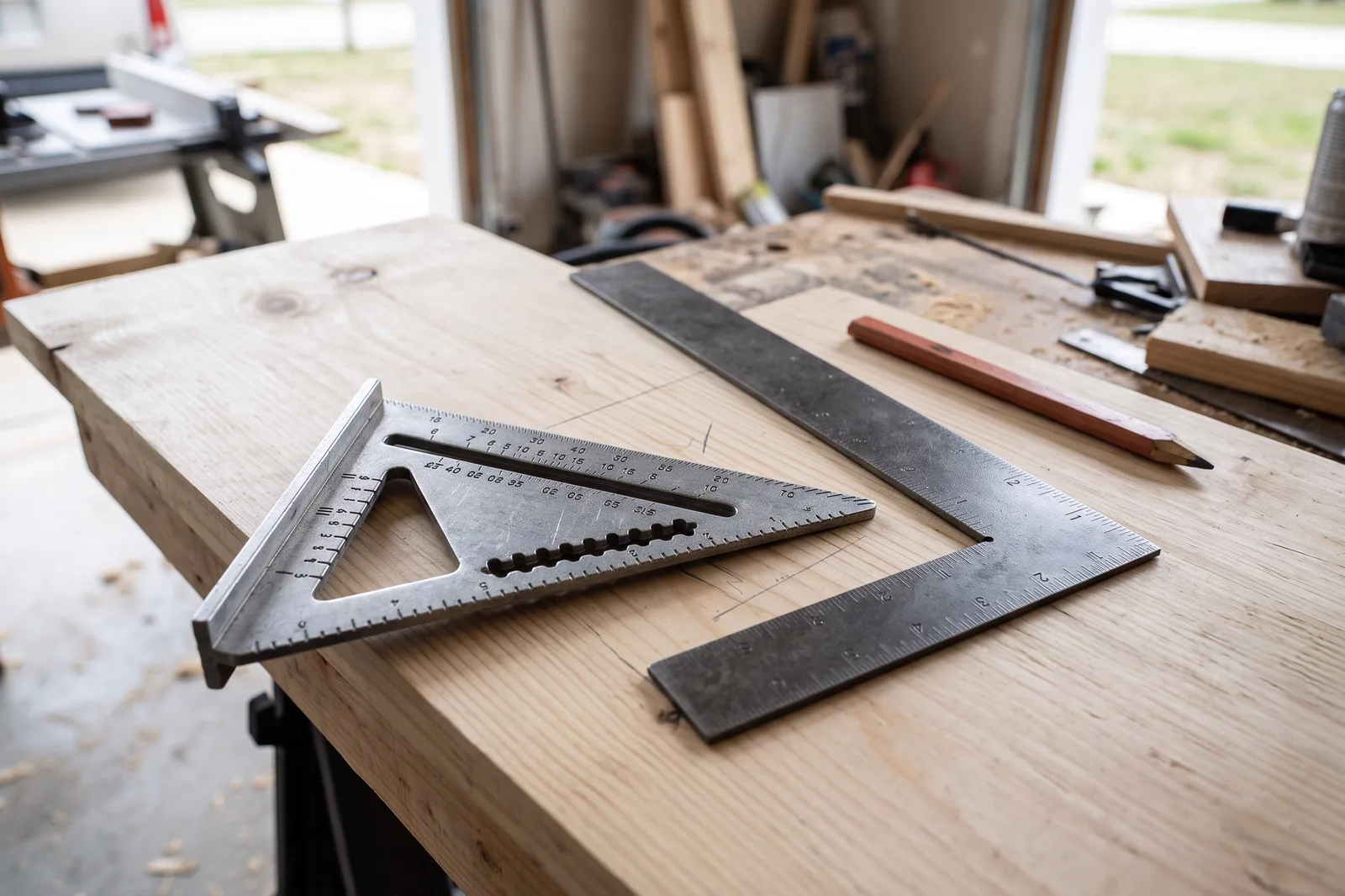 Measuring & LayoutSpeed Square and Framing Square: Two Layout Tools Worth OwningA speed square is a small aluminum triangle for marking square and angled cuts on boards, and a framing square is a large steel L for checking corners and laying out stairs and rafters.
 Measuring & Layout · RoundupMultimeters and Voltage Testers: Which to Own at HomeA non-contact voltage pen tells you if a wire may be live, a plug-in outlet tester checks wiring on the spot, and a multimeter gives actual numbers.