
Workshop & Storage · Roundup · DIY · Maker
Clamps for Woodworking and Repairs: The 5 Types Worth Owning
Quick answer
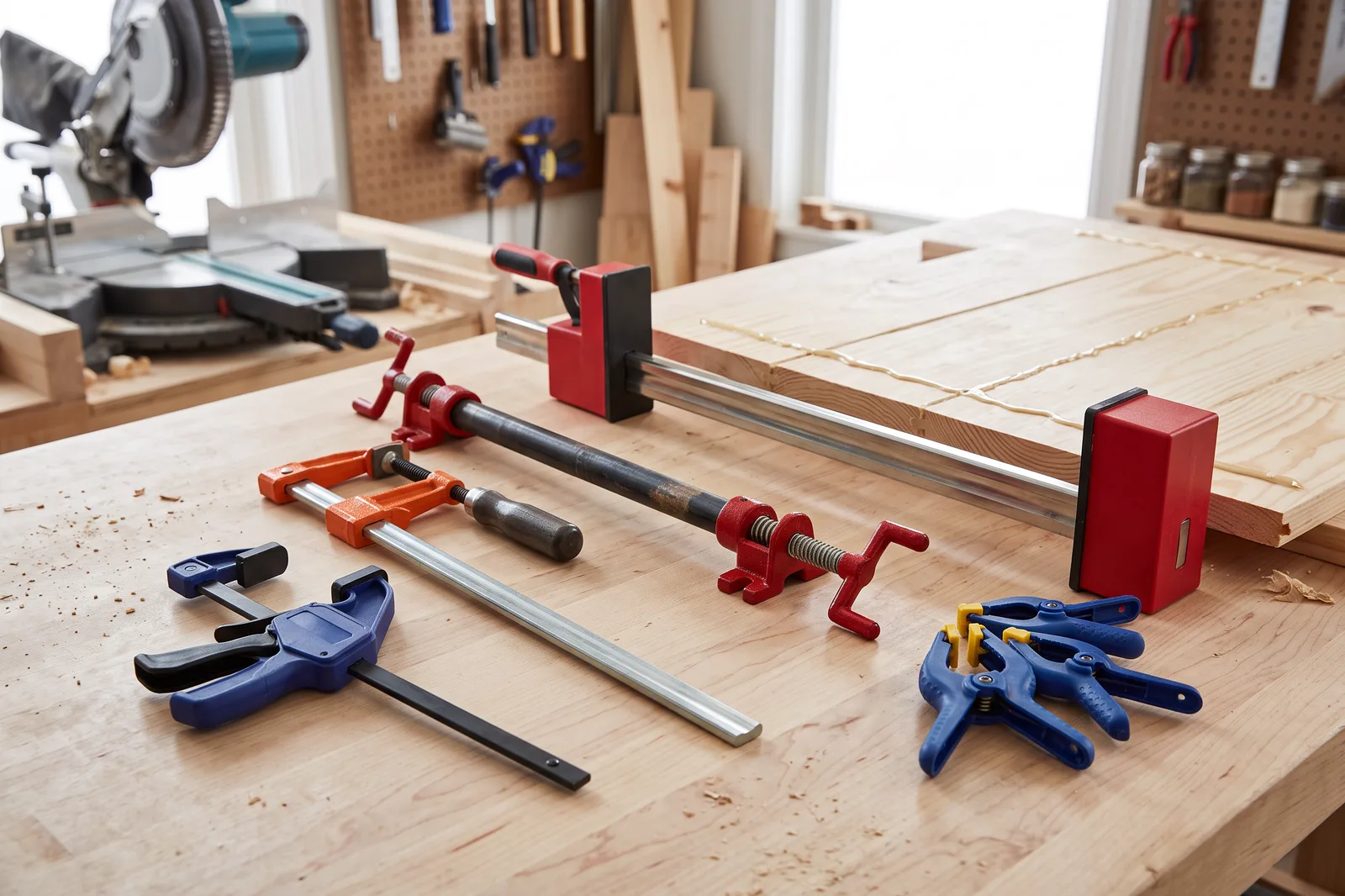
Start with a pair of one-handed bar clamps and a few spring clamps for quick holds, add two F-style clamps for real pressure, then a set of 3/4-inch pipe clamps for wide glue-ups. Parallel clamps like the Bessey REVO are the premium step for flat, square panels and cabinets; most beginners can wait on them.
What are the clamps worth owning?
A clamp is a tool that squeezes two or more parts together and holds them still. Woodworkers use clamps to hold glued joints closed while the glue dries, and everyone else uses them as a spare pair of hands: holding a board to the bench while you cut it, keeping trim in place while you nail it, or pinning a cracked chair rung while the glue sets.
There are dozens of clamp styles, but a home shop is built on five:
| Clamp type | What it does best | Force | How many to start |
|---|---|---|---|
| One-handed bar clamp | Quick holds while you drill, screw or mark | Light to medium | 2 |
| F-style bar clamp | Strong pressure on small parts and repairs | High | 2 |
| Pipe clamp | Edge-gluing boards into wide panels and tabletops | High | 4 |
| Parallel clamp | Flat, square glue-ups for cabinets and panels | Very high | 2 (later) |
| Spring clamp | Templates, light parts, drop cloths, tarps | Light | 6 |
We picked one well-reviewed model for each: the IRWIN QUICK-GRIP 12-inch one-handed clamp, the Pony Jorgensen 3712-HD F-style clamp, the BESSEY BPC-H34 pipe clamp, the BESSEY K Body REVO KRE3524 parallel clamp and an IRWIN spring clamp six-pack. We chose them from the makers' listings, buyer feedback on Amazon, Home Depot and woodworking forums, an eight-brand parallel clamp test by 731 Woodworks and beginner buying guides from woodworking channels we checked.
The order you buy them in matters more than the brand. In the beginner guides we reviewed, the most common regret is buying the cheapest trigger clamps (they break) or buying expensive parallel clamps too early (pipe clamps do most of the same work).
Why you'll want them
Glue needs pressure and time. Wood glue is stronger than the wood itself, but only if the joint is held closed while it dries, usually for at least 30 minutes and ideally overnight before stress. Nothing else in a toolbox does that job.
They free up your hands. Drilling a hole in a board you are also holding is how bits wander and fingers get hurt. A clamp holds the work so both hands can run the tool. This is the main reason people who never glue anything still keep a pair of one-handed clamps.
They make repairs possible. A wobbly chair, a split cabinet door or a loose drawer front all come down to the same fix: glue in the joint, clamp it, wait. Without clamps the joint dries open and fails again.
They keep work square and flat. When you glue boards into a panel, clamps alternated above and below the boards stop the panel from bowing. Parallel clamps go one step further by keeping their jaws exactly square to the bar.
They act as stops and guides. A clamp holding a straight board to a sheet of plywood turns it into a saw guide. A spring clamp on a fence makes a quick stop block for repeat cuts.
Cheap ones cost more in the end. Buyers and reviewers repeat the same story: bargain trigger clamps crack or slip, and thin-bar F-clamps bend under pressure. A few good clamps beat a bucket of bad ones.

Who it's for
- First-time woodworkers gluing up shelves, boxes, cutting boards and simple furniture
- Homeowners doing repairs like regluing a chair rung, holding trim while it sets or fixing a loose drawer
- DIYers who work alone and need a second pair of hands while they drill or screw
Who should skip it
- Metal fabricators who weld. Welding clamps and locking C-clamps stand up to spatter; these are woodworking clamps.
- Anyone who only hangs pictures and assembles flat-pack furniture. One small one-handed clamp is plenty.
- Beginners tempted to buy parallel clamps first. Pipe clamps do most of the same glue-ups for far less outlay.
How to use them
These steps follow the technique shown in the beginner videos we checked and apply to every clamp type.
- Pick the clamp for the job. One-handed clamps for holding, F-style for strong squeeze on small parts, pipe or parallel clamps for anything wider than about 12 inches.
- Dry fit first. Put the parts together and clamp them without glue. The joint should close with modest pressure. A clamp will not fix a badly cut joint, so fix gaps now.
- Lay out every clamp before the glue goes on. Open each one to roughly the right size and line them up within reach. Glue starts to set in minutes.
- Pad the jaws. If a clamp has bare metal jaws, put a scrap block of wood between the jaw and the work so it does not dent the surface.
- Space the clamps evenly. On a panel glue-up, place a clamp roughly every 8 to 12 inches and alternate them above and below the boards so the panel stays flat.
- Snug, then align, then tighten. Close each clamp until it just touches, check that the faces of the boards line up, then tighten a little more on each clamp in turn.
- Stop at a glue bead. You want a thin, even bead squeezing out along the joint. Cranking harder forces glue out of the joint and can crush soft wood.
- Check for square. On boxes and cabinets, measure the diagonals; if they match, the box is square. Shift a clamp slightly at an angle to pull it into square if needed.
- Scrape the glue while it is rubbery. About 20 to 30 minutes in, squeeze-out peels off cleanly with a scraper or chisel.
- Clean your clamps. Knock dried glue off the jaws and bars. Old glue lumps dent your next project and stop jaws sliding.
Common mistakes
- Over-tightening. Starving the joint of glue makes it weaker, not stronger.
- Clamping only one side of a panel. All clamps on one face pull the panel into a curve.
- Using spring clamps for glue-ups that need pressure. They are for light holds only.

What to look for when buying
Clamping force for the job. Listings rate clamps in pounds. The IRWIN one-handed clamp is rated at 300 lbs of sustained pressure, the Jorgensen 3712-HD at a 1,000 lb maximum load and the Bessey REVO at 1,700 lbs nominal force. These are maker figures, not independent tests. Fine Woodworking measured an earlier generation of the REVO at well below its rating, so treat ratings as a comparison between clamps rather than a promise.
A stiff bar. The most common complaint about cheap F-clamps and bar clamps is a thin bar that flexes or bends under pressure, which twists the work. Look for a thick steel bar like the Jorgensen's or an I-beam profile like the IRWIN's.
Length that fits your projects. Twelve-inch clamps handle small parts and repairs. For shelves, cabinet sides and cutting boards, 24 to 36 inches is the useful range; the 731 Woodworks beginner guide suggests 36 inches if you can only afford one length of long clamp. Pipe clamps solve the length problem by letting you buy the pipe to suit.
Pads that protect the work. Soft jaw pads or caps save you from cutting scrap blocks every time. The Bessey pipe clamp includes soft jaw caps, and the IRWIN and Bessey REVO pads are removable for cleaning.
Stable feet. Pipe and parallel clamps that stand up on their own are far easier to load during a glue-up. Bessey's H-style foot is designed for this and gives finger clearance under the crank, which buyers often mention.
Quality control on trigger clamps. A recurring theme on woodworking forums is that some newer trigger clamps slip once they reach moderate pressure. Test each clamp when it arrives and return any that slip.
Buy in pairs. Almost every clamping job needs at least two clamps. Pipe clamps are usually bought in fours for panels.
Key specs to look for
| Spec | What to look for |
|---|---|
| Clamp type | Match the clamp to the job: one-handed for quick holds, F-style for strong pressure on small parts, pipe or parallel for wide glue-ups, spring for light work. |
| Opening capacity | The widest gap the jaws open to. 12 inches covers most small parts; 24 to 36 inches covers shelves and cabinet sides. Pipe clamps are as long as the pipe you buy. |
| Throat depth (reach) | How far the jaw reaches in from the edge of the work. About 3 inches is common on the clamps here; deeper reach lets you press the middle of a wide part. |
| Clamping force | Listings give a rated figure in pounds. Trigger clamps hold a few hundred pounds; screw clamps reach roughly a thousand or more. More is not always better on soft wood. |
| Jaw pads | Soft or plastic pads stop metal jaws denting the wood. Removable pads are easy to clean of glue or replace. |
| Bar design | Thicker steel bars bend less under load. Thin bars on cheap F-clamps flex, which is the most common complaint about bargain sets. |
| Spreader mode | Some clamps flip a jaw to push outward, useful for separating parts or pushing a joint apart during a repair. |
Where to get them
All five are sold on Amazon. We rate the IRWIN one-handed clamp, the Bessey pipe clamp and the IRWIN spring clamps as budget tier, the Jorgensen as mid tier and the Bessey REVO as pro tier. Check the size and pack count in each listing before you buy; most of these are sold singly, and makers sell the same clamp in several lengths.
| Pick | Best for | What buyers like | What buyers flag |
|---|---|---|---|
| IRWIN QUICK-GRIP 12 in. | First clamp, quick holds, working alone | One-handed speed, spreader mode, pads that do not mark | Some report newer clamps slipping at higher pressure |
| Jorgensen 3712-HD | Strong pressure on small parts and repairs | Thick bar, big comfortable handle, high force | Slower to set than a trigger clamp; heavier |
| Bessey BPC-H34 pipe clamp | Panels, tabletops, long glue-ups | Any length, stands on its H foot, strong Acme screw | Pipe sold separately; pipe can mark wood without pads |
| Bessey REVO KRE3524 | Cabinets, drawers, flat panels | Jaws stay parallel, high force, hex socket for a driver | Costs far more per clamp than pipe clamps; heavy |
| IRWIN spring clamps 6-pack | Templates, light parts, tarps | Cheap, quick, grip round stock | Light pressure only; not for real glue-ups |
IRWIN QUICK-GRIP one-handed bar clamp. The listing describes a 12-inch medium-duty clamp with a 3-3/16-inch throat, a quick-release trigger, a quick-change button that turns it into a spreader, locking swivel jaws and non-marring pads, rated for 300 lbs of sustained pressure. The 731 Woodworks beginner video recommends IRWIN over the bargain trigger clamps the channel bought first, most of which broke. Forum buyers love the speed and say they grab these for most everyday holds, while a common complaint is that some newer clamps slip under heavier pressure. Buy a pair.
Pony Jorgensen 3712-HD F-style clamp. A heavy-duty steel bar clamp with a 12-inch opening, a 3-inch reach and thick plastic pads, rated to a 1,000 lb maximum load and assembled in Pony's Chicago factory from U.S. and foreign parts, per the listing. The 731 Woodworks beginner guide names Jorgensen F-clamps as the channel's favorite for their thick bar and large handle, and warns off thin-bar bargain F-clamps that bend. Expect it to be slower to set than a trigger clamp, and heavier. Note that an F-clamp is sized by its opening, not its overall length, as Rocky River Woodworks points out: this one takes work up to 12 inches thick or wide. The same video warns that long F-clamp bars can slowly bow after years of hard cranking, which is one more reason to buy a solid bar and to use pipe or parallel clamps for long spans.
BESSEY BPC-H34 pipe clamp. A two-piece clamp for 3/4-inch pipe: the front jaw with its Acme-threaded screw threads onto one end of the pipe, and the rear jaw slides along it with clutch plates that lock in place, per the listing. The H-shaped foot stops it tipping and gives finger clearance, and soft jaw caps are included. The 731 Woodworks guide recommends Bessey pipe clamps as an inexpensive way to add a lot of clamping capacity for cutting boards, tabletops and other panel glue-ups. You buy the pipe separately at a hardware store, threaded on at least one end.
BESSEY K Body REVO KRE3524 parallel clamp. A 24-inch parallel clamp with a profiled steel rail, a jaw that stays put while you set up, a two-part handle with a steel socket for a hex key, and 1,700 lbs nominal clamping force, per the listing. It comes with three removable glue-proof jaw pads, two rail pads and an end clip. In 731 Woodworks' eight-brand test it ranked best overall for build quality, drop-test durability and warranty. Home Depot and other buyer reviews praise the force and smooth jaw; the most common complaint is price. Rocky River Woodworks explains the main advantage over an F-clamp: the parallel jaw face is around three inches tall instead of a small round pad, so pressure is spread evenly from top to bottom and the panel is less likely to bulge in the middle. Treat it as an upgrade once you build cabinets or many panels.
IRWIN QUICK-GRIP spring clamps, six-pack. Six spring clamps in three sizes with pivoting jaw tips and V-groove pads that grip round stock, per the listing. Spring clamps are the cheapest way to hold templates, light trim, edge banding and tarps, and both beginner videos keep a handful within reach. They do not apply enough pressure for structural glue-ups.
What to buy first: two IRWIN one-handed clamps and the spring clamp pack, then two Jorgensen F-clamps, then four Bessey pipe clamps when you start gluing panels. Add Bessey REVO parallel clamps last, if your projects call for them.

IRWIN QUICK-GRIP One-Handed Bar Clamp, Medium-Duty, 12 in. (1964718)
- Squeeze the trigger to close it with one hand; a release trigger opens it instantly
- Rated for 300 lbs of sustained clamping pressure, per the listing
- Converts to a spreader and has non-marring pads that will not dent wood
How we scored it
Usefulness 9/10 · Value 9/10 · Durability 7/10. This is our own opinion, based on specs, buyer reviews and independent tests. It is not an Amazon or customer rating.

Pony Jorgensen 3712-HD 12 in. Heavy-Duty Steel Bar Clamp
- Screw handle applies far more force than a trigger clamp: 1,000 lb maximum load, per the listing
- 12-inch opening and 3-inch reach, with thick plastic protective pads
- A favorite F-style clamp of the 731 Woodworks channel for its thick bar and big handle
How we scored it
Usefulness 8/10 · Value 8/10 · Durability 9/10. This is our own opinion, based on specs, buyer reviews and independent tests. It is not an Amazon or customer rating.

BESSEY BPC-H34 3/4 in. H-Style Pipe Clamp
- Fits standard 3/4-inch pipe, so one clamp can be any length you need
- H-shaped foot stands the clamp up and keeps your fingers clear of the bench
- Acme-threaded screw and cast jaws with soft caps included, per the listing
How we scored it
Usefulness 9/10 · Value 9/10 · Durability 9/10. This is our own opinion, based on specs, buyer reviews and independent tests. It is not an Amazon or customer rating.

BESSEY K Body REVO 24 in. Parallel Clamp (KRE3524)
- Jaws stay parallel and square to the rail, which keeps panels and cabinets flat
- 1,700 lbs nominal clamping force, per the listing; converts to a spreader
- Ranked best overall in 731 Woodworks' eight-brand parallel clamp test
How we scored it
Usefulness 8/10 · Value 7/10 · Durability 9/10. This is our own opinion, based on specs, buyer reviews and independent tests. It is not an Amazon or customer rating.

IRWIN QUICK-GRIP Spring Clamps, 6-Pack, Multiple Sizes (IRHT83241)
- Six clamps in three sizes for light holds, templates and drop cloths
- Pivoting jaw tips spread pressure evenly, per the listing
- V-groove pads also grip round stock like dowels and pipe
How we scored it
Usefulness 7/10 · Value 9/10 · Durability 7/10. This is our own opinion, based on specs, buyer reviews and independent tests. It is not an Amazon or customer rating.
Watch and read more
Video reviews
- 99% of Beginners Don't Know Which Clamps to Buy and AVOID! — 731 Woodworks
Walks through the clamps a beginner should buy in order: squeeze clamps (Irwin recommended, cheap ones broke), F-clamps (Jorgensen his favorite), Bessey pipe clamps, corner squares and spring clamps, with parallel clamps saved for later. - What Every Beginner Should Know About Clamps — Fabricator's Field Guide
Shows an edge glue-up and explains that clamps hold joints rather than force them: dry fit first, tighten just to a glue bead, pad metal jaws and keep clamps clean. - 5 Types Of Clamps You Need In Your Shop | Must Have Woodworking Clamps — Rocky River Woodworks
Explains F-style, pad (face), parallel and specialty clamps: an F-clamp size is its opening, long F-clamp bars can bow over time, and parallel clamps spread pressure over a wide jaw to keep tabletop and cabinet glue-ups flat.
PROSWho uses it
- Matt Outlaw (731 Woodworks) — Tested eight brands of 24-inch parallel clamps and ranked the Bessey REVO best overall; also recommends Irwin squeeze clamps and Jorgensen F-clamps in his beginner clamp guide.
Free calculators FigureMyHome
- Feet-Inch Fraction Calculator — Add up board widths to know how long your clamps need to be.
Frequently asked questions
What clamps should a beginner buy first?
A pair of 12-inch one-handed bar clamps, a pack of spring clamps and two F-style clamps cover most first projects. Add four 3/4-inch pipe clamps when you start gluing boards edge to edge into panels.
How many clamps do I really need?
For edge-gluing a panel, plan on one clamp roughly every 8 to 12 inches along the joint, alternating above and below the boards. A shelf or tabletop of three or four boards usually needs three to five clamps.
Are pipe clamps as good as parallel clamps?
For most panel glue-ups, yes. Parallel clamps keep their jaws square and flat, which helps on cabinets and drawers, and they are easier to set up. Pipe clamps do the same basic job at a fraction of the cost and can be any length.
What size pipe should I use with pipe clamps?
Buy the pipe size the clamp is made for. The Bessey BPC-H34 fits 3/4-inch black iron pipe. Woodworkers commonly prefer 3/4-inch over 1/2-inch because the thicker pipe bends less under pressure.
How tight should I clamp a glue joint?
Only tight enough to close the joint and squeeze out a thin bead of glue along its length. Over-tightening forces too much glue out and can crush soft wood. A good joint should come together with modest pressure in a dry fit.
Why do my clamps leave dents in the wood?
Bare metal jaws press into wood fibers. Use clamps with soft pads, or put a scrap block of wood between the jaw and the work to spread the pressure.
Do one-handed clamps slip?
Some buyers on woodworking forums report newer trigger clamps slipping after moderate pressure. They are meant for holding and light-to-medium glue-ups; for strong pressure, use an F-style, pipe or parallel clamp.
Sources
- 731 Woodworks: The best parallel clamp for any budget (eight-brand test)
- 731 Woodworks: Ultimate beginner's guide to woodworking clamps
- Fine Woodworking: Bessey K Body Revo clamp review (earlier generation)
- Toolbox Buzz: Bessey K Body REVO clamps
- Canadian Woodworking: 6 trigger/spreader clamps tested
- Woodsmith: The essential clamps every woodworker needs
- Fine Woodworking forum: Quick-Grip quality and slipping reports
- Home Depot customer reviews: Bessey KRE3524
Related tools
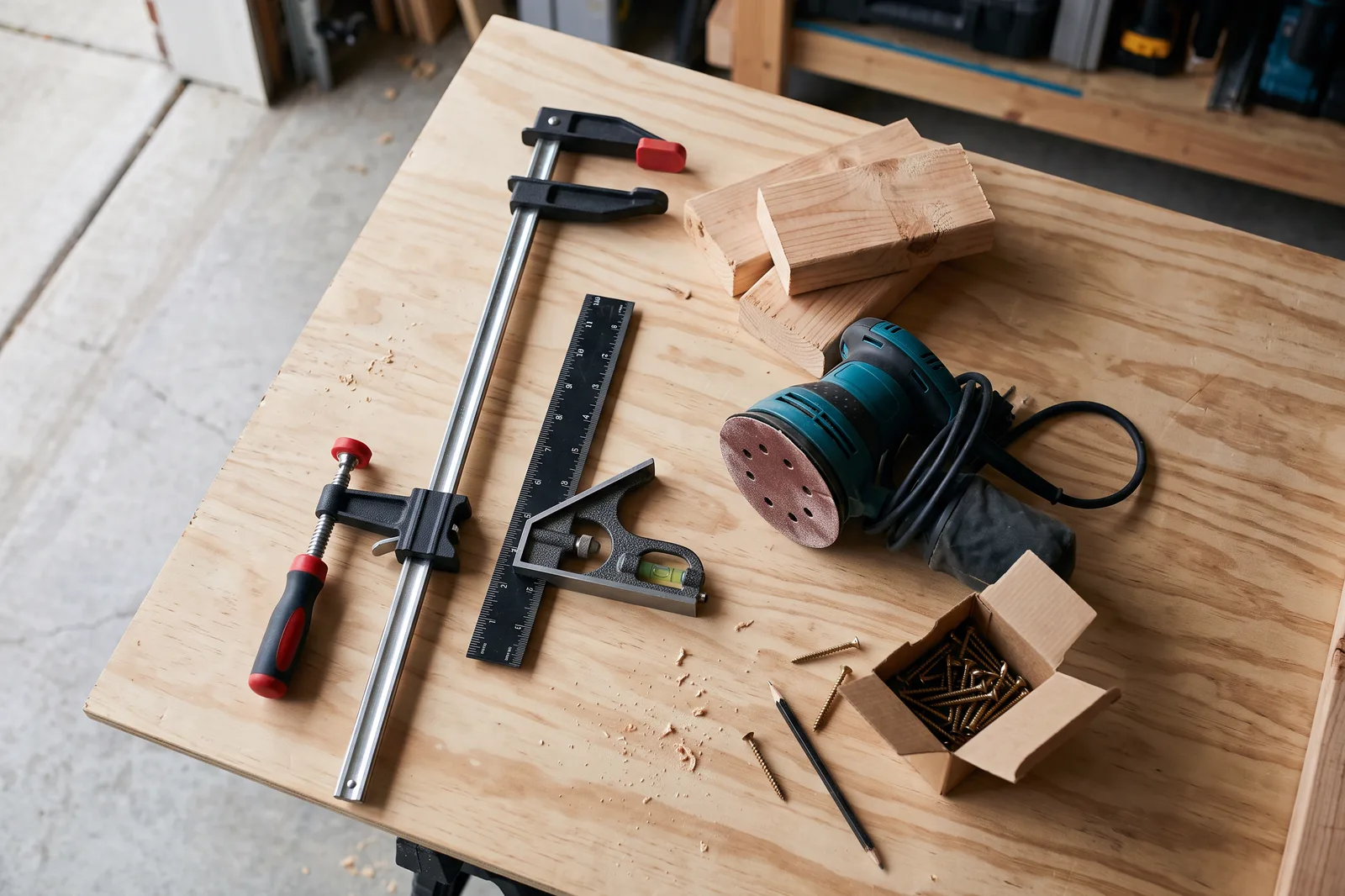 Workshop & StorageTools Needed to Build a Simple WorkbenchA simple workbench is 2x4 legs and rails with a plywood or MDF top, so you need a saw, a cordless drill/driver, a tape measure, a square and a few clamps.
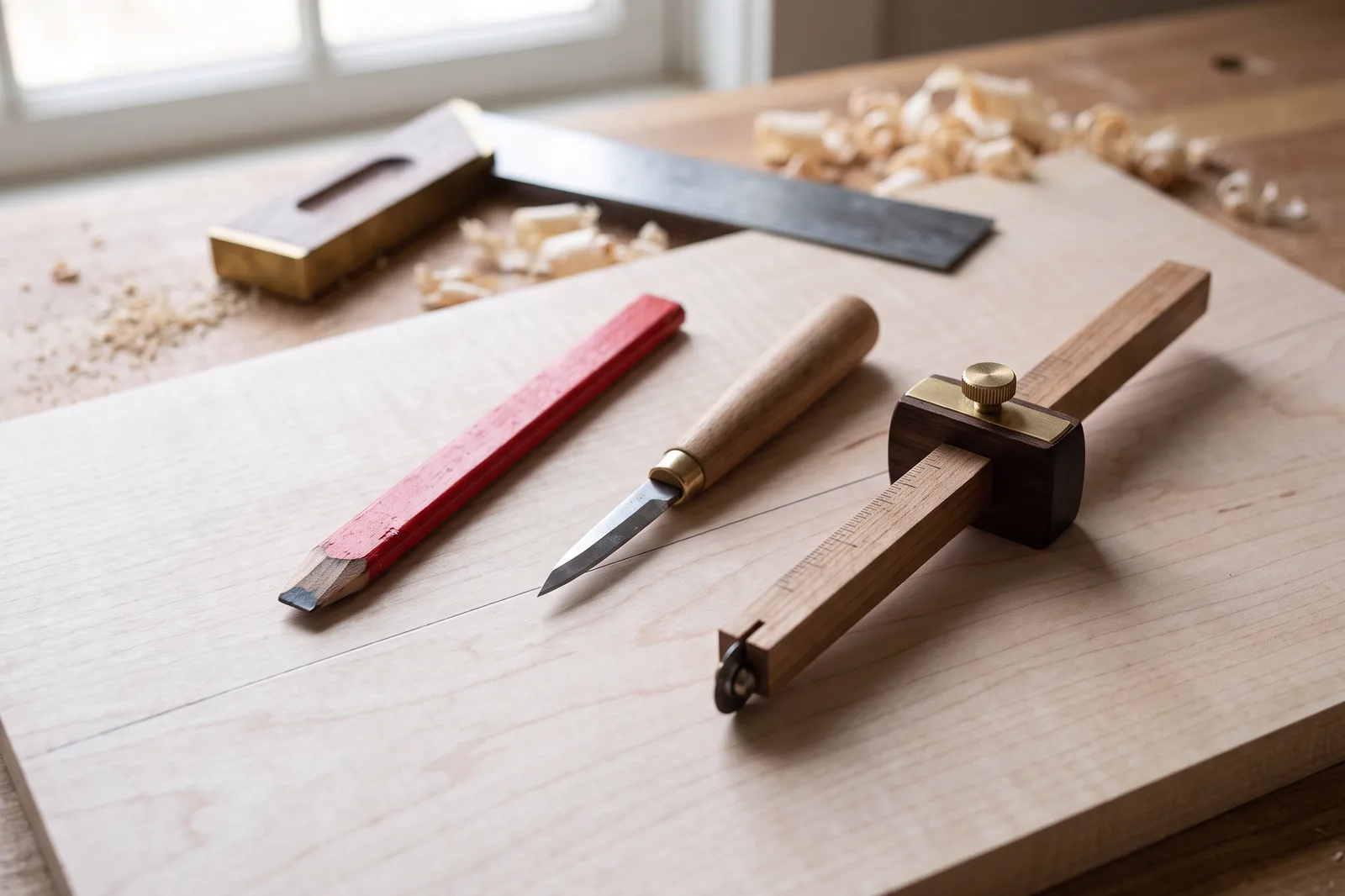 Measuring & LayoutMarking Tools for Woodworking: Pencils, Knives and Gauges ComparedUse a pencil for rough layout and a marking knife or gauge for anything that has to fit.
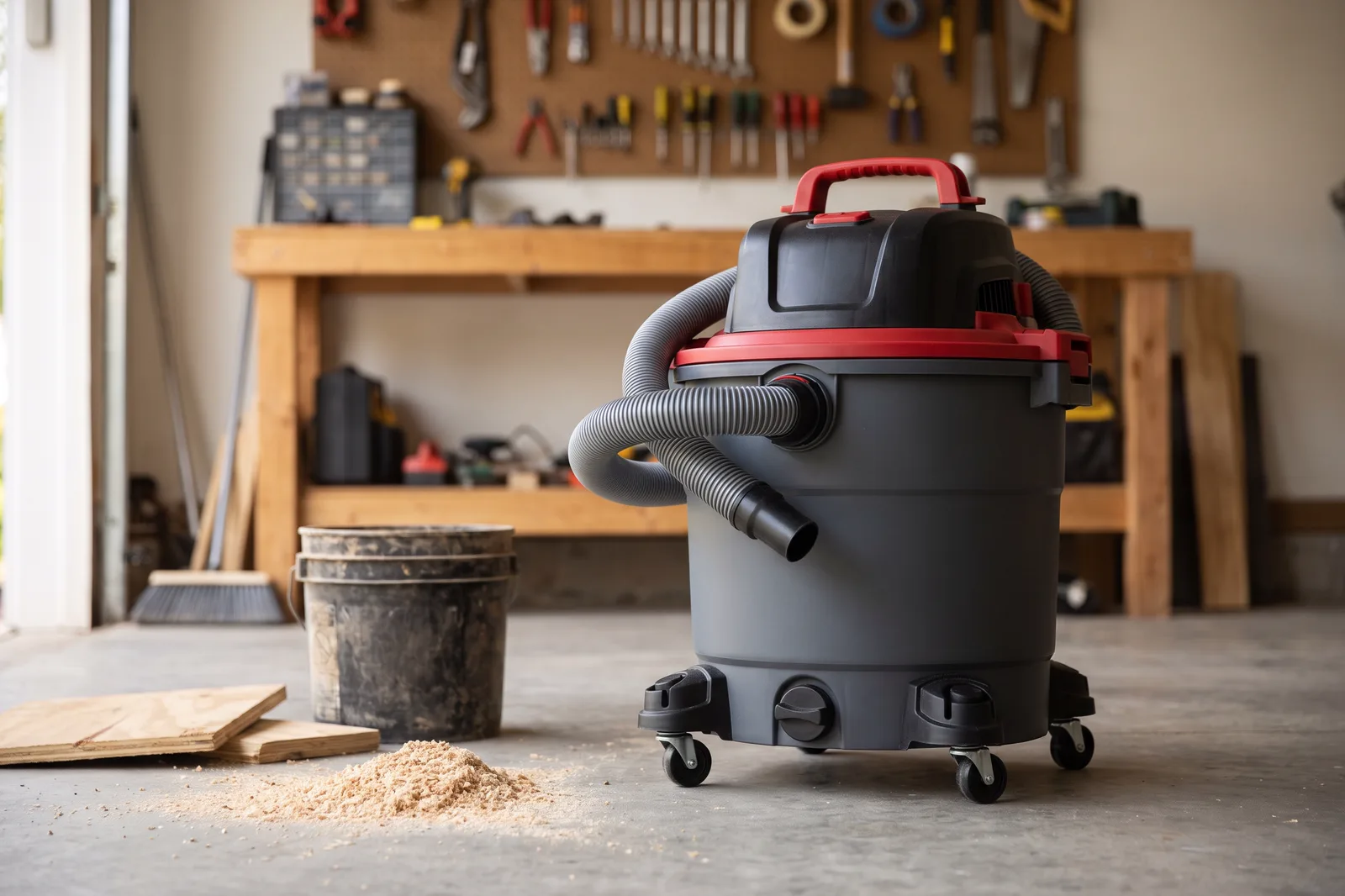 Workshop & StorageShop Vacuum: The Wet/Dry Cleanup Tool Every Garage NeedsA shop vacuum is a tough wet/dry vacuum that sucks up sawdust, drywall scraps and spilled water that would wreck a household vacuum.